Increase the Revenues of Your Waste Company With the Tips Shared in Our Blog Articles
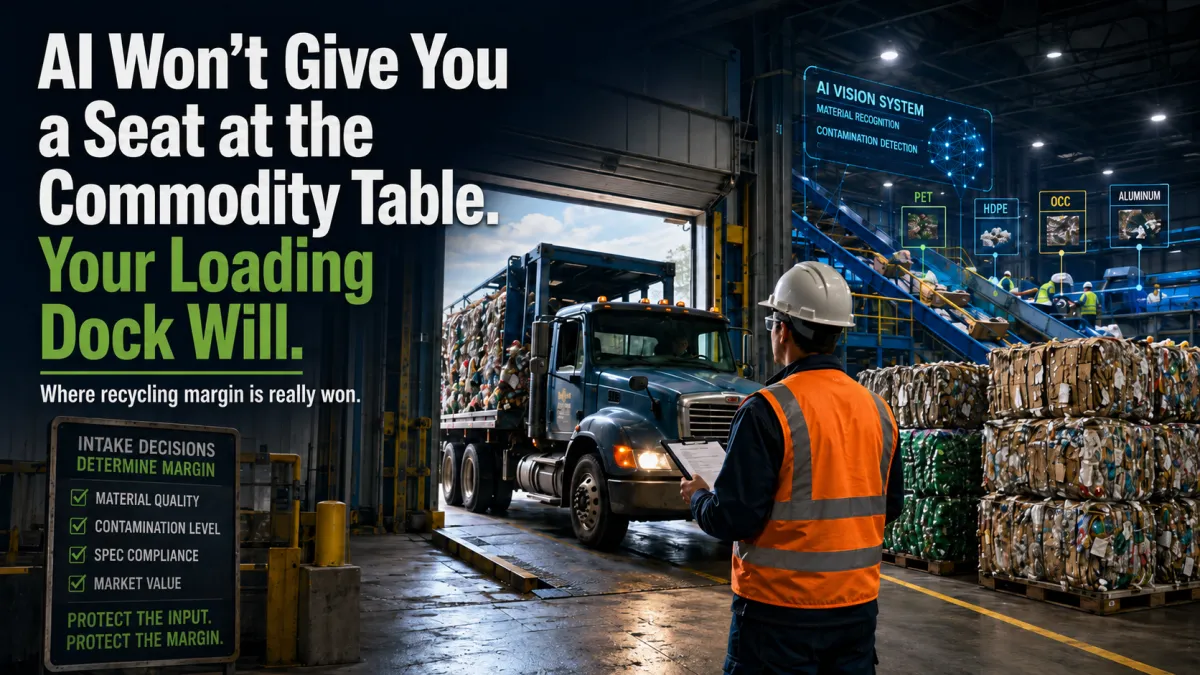
AI Won't Give You a Seat at the Commodity Table. Your Loading Dock Will.
The purity of your bale is decided before it ever touches the sort line. It's decided at the gate, by what you agreed to accept. No algorithm reaches back in time and un-contaminates a load you already took.
Keep that in mind this month, because the trade press has been selling you the opposite story.
Open any waste or recycling outlet right now and you'll read the same pitch in five different fonts: install the vision system, bolt AI onto the sortation line, produce cleaner bales, and those cleaner bales command higher prices on the commodity market. Do that, and you finally earn a "seat at the commodity trading table." Buy the intelligence, get the margin.
Half of that is true. The half they leave out is where your money actually is.
The part they get right
Purity is the price lever. That much is real. A bale with contamination fetches a discount, or gets rejected, or quietly becomes residue you pay to landfill twice — once in lost commodity value, once in a tipping fee. A clean bale sells. Nobody serious argues with that.
So yes: if the material coming down your line is cleaner, you make more money. Agreed. Settled.
The sleight of hand is in where purity gets decided. The vendor story implants a false assumption — that purity is created on the sort line. It isn't. It's created, or destroyed, at intake. The sort line only reveals what you already own.
A vision system sorting a stream nobody characterized is a machine configured for an average week that never actually shows up at your dock. You tuned it for a feedstock mix that exists in a spec sheet, not in your inbound. Monday's load is 8% film contamination. Thursday's is 22%. The machine doesn't fix that swing. It processes it — faster, at a higher electric bill, and now you've financed the privilege.
The example they're using against you
Here's the case study every vendor deck leans on, and it's worth looking at closely because it proves the exact opposite of what they claim.
Waste Management has publicly committed on the order of $1.4 billion to automate its material recovery facilities, targeting roughly 90% of them automated by 2027. And the results look strong — recycling EBITDA grew meaningfully in 2025 even while commodity prices fell. The pitch writes itself: see, AI converts straight into margin.
Now read what's missing from that slide.
WM doesn't win because it bought vision systems. WM wins because it already owns the thing the vision system depends on: control of the inbound stream at a scale you and I don't have. National contracts. Transfer stations. Years of characterization data by source and route. The leverage to re-price or refuse a dirty load and make it stick. WM bought the last 10% of the equation. It already owned the 90%.
You're being sold the 10% and told it's the whole game.
Copy WM's AI move without WM's input control and you don't get WM's result. You get a very expensive, very fast way to sort the same contaminated stream you were already losing money on — with a financing payment attached.
Where your margin is actually leaking
Your margin is not bleeding out on the sort line. It's bleeding at the scale house.
It leaks every time a contaminated load rolls across your scale and gets billed at the clean-load rate. Every time your crew burns labor and downtime pulling out material that should never have entered the building. Every time a downgraded bale ships at a discount because one supplier's junk poisoned the batch. Every time you tip residue you paid to receive.
That is money you already own. It walks back out your gate as residue, and you wave at it on the way out.
Software doesn't see that leak, because the leak happened upstream of the software. The vision system is measuring a decision you made an hour earlier at the dock — the decision to open the door and not ask what was behind it.
What controlling the dock actually looks like
Input control isn't a machine. It's a set of decisions you're currently giving away for free:
Characterize your inbound by source and by route. You cannot price what you refuse to measure. If you don't know which generators send you clean material and which send you sorting cost dressed up as tonnage, you're subsidizing the dirty ones with the clean ones' margin.
Price contamination back to the generator. A contaminated load is not a neutral event you absorb. It's a cost with a name and an address. Surcharge it, or reject it, and watch behavior change within one billing cycle.
Make the loading dock a decision point, not a doorway. Right now it's a doorway — material comes in because it showed up. The operators who make money treat intake as the single highest-leverage checkpoint in the building.
Know your feedstock composition before you configure any machine. Buying automation ahead of understanding your inbound stream is the most expensive mistake in this business. Independent operators are saying the same thing out loud now: characterize first, automate second.
None of that requires a $1.4 billion budget. It requires you to stop treating your gate as a formality.
So where does AI actually belong?
Not in the trash. On a controlled stream, AI is a genuine multiplier — and this is the part I want to be precise about, because I've published on where machine intelligence creates real value in this sector.
Once you control what comes in, a vision system does something valuable: it turns quality from an argument into a number. It gives you a complete record of what actually moved down the line, by material and by hour. That measurement layer lets you defend your price with data instead of a handshake, prove your bale spec to a buyer, and hold the generator accountable for what they sent. That's real. That's worth paying for.
But every one of those benefits assumes the stream is already under control. AI is the amplifier. It is not the signal. Point it at a controlled input and it compounds your advantage. Point it at chaos and it just documents your losses in higher resolution.
The seat at the commodity table was never bought with software. It's earned at the dock, by the operator who decided what was allowed to become his problem in the first place.
If you don't know — to the dollar — what contamination is costing you per inbound load, that's not a software gap. That's the leak. And it's the first number I'd want to find with you.
To Your Success
Sam
The Waste Management Alchemist
Sam Barrili helps waste and recycling operators find the margin they already own inside their own streams. If you want to know what your inbound is actually costing you, book a free 20-minute Profit Qualification Call: https://sambarrili.com/schedule-free-20min-call

© 2026 Marketing4waste - All Rights Reserved,
Marketing4Waste is a brand of MiM MarketingInterimManagers LLC
+1 801 804 5730