Increase the Revenues of Your Waste Company With the Tips Shared in Our Blog Articles

The Responsibility Short-Circuit
How Governments Shift the Burden to Citizens — And Destroy Waste Value in the Process
For years, governments have promoted a simple narrative:
“Waste separation starts at home.”
Citizens are educated.
Citizens are trained.
Citizens are fined.
Citizens are morally pressured.
At the same time, waste management companies are subjected to:
Recovery targets
Contamination limits
Emission standards
Fleet modernization mandates
Traceability requirements
ESG reporting obligations
On paper, it looks collaborative.
In reality, it creates a structural short-circuit.
And that short-circuit is destroying value.
Let me explain.
1. The Government’s Strategic Move: Responsibility Transfer
When a municipality introduces door-to-door separation, what is it really doing?
It is transferring part of the operational burden to citizens.
Instead of designing:
Highly optimized industrial sorting systems
Centralized advanced recovery facilities
AI-driven material classification
The government says:
“You separate.”
From a political standpoint, it’s brilliant.
It reduces visible infrastructure investment.
It distributes responsibility.
It creates the illusion of participation.
But here is the structural problem:
Responsibility is fragmented. Accountability is not.
Waste companies remain accountable.
Citizens are not economically aligned.
That’s where the short-circuit begins.
2. Dual Responsibility = Conflicting Incentives
Let’s analyze the two actors.
Citizens:
No direct economic benefit
No exposure to contamination penalties (beyond minor fines)
No knowledge of material markets
No understanding of polymer grades or fiber quality
Their incentive is compliance — not optimization.
Now let’s look at:
Waste Management Companies:
Paid based on service contracts
Penalized for contamination
Dependent on resale value of recovered materials
Exposed to commodity price volatility
Required to meet recovery quotas
Their incentive is value maximization and regulatory compliance.
Do you see the gap?
The citizen operates emotionally and behaviorally.
The waste company operates economically and structurally.
When the first actor feeds the second actor inconsistent material, value erodes.
3. The Value Leakage Mechanism
Let’s follow one plastic bottle.
In an ideal industrial system:
Material is collected in high-volume streams
Optical sorters identify polymer type
Contamination is controlled
Moisture is limited
Bale quality is consistent
In a door-to-door, home-sorting system:
Bottle may be contaminated with food
It may be mixed with wrong polymer
It may sit in rain
It may be compressed incorrectly
It may be stored with organic residue
Multiply that by millions of units.
You don’t lose percentage points.
You lose material grade.
And in secondary raw materials markets, grade defines price.
Lower grade = lower revenue.
Lower revenue + higher operational cost = margin compression.
This is the short-circuit.
4. The Structural Contradiction
Governments say:
“Citizens must separate to increase recycling.”
At the same time, they impose on waste companies:
Quality thresholds
End-of-waste compliance
Environmental certifications
Reporting standards
So we have:
Upstream: behavioral variability
Downstream: industrial rigidity
That’s incompatible.
You cannot build a high-precision recovery system on low-precision input.
It’s like asking a refinery to operate efficiently using randomly mixed crude.
The loss of waste value is not accidental.
It is systemic.
5. More Separation ≠ More Value
Another illusion is the idea that more fractions equal more recovery.
In practice, more fractions mean:
Smaller collection volumes per fraction
Higher transport cost per ton
More fleet hours
Increased fuel consumption
More exposure to dispersion
Meanwhile, industrial Material Recovery Facilities are designed to operate at scale.
Scale reduces cost per ton.
Scale increases sorting efficiency.
Scale improves material grade.
Fragmentation does the opposite.
When you fragment collection at the citizen level, you reduce system density.
And density is the foundation of industrial profitability.
6. The Environmental Irony
Let’s talk emissions.
Door-to-door separation increases:
Number of trucks
Number of routes
Partial loads
Urban congestion
At the same time, governments demand:
Low emission fleets
Electrification
Noise reduction
Carbon accounting
So waste companies must invest in:
Expensive electric trucks
Charging infrastructure
Route redesign
Data monitoring systems
All while transporting lower-grade materials.
That’s not environmental strategy.
That’s operational contradiction.
7. The Psychological Comfort vs Economic Reality
Citizens feel virtuous separating waste.
Politicians feel effective publishing recycling percentages.
But waste companies feel the pressure in their balance sheets.
The system is built around perception.
The market is built around price.
And price reacts to quality, density, and efficiency.
Not to good intentions.
8. The Real Responsibility Question
Who should be responsible for material optimization?
The individual citizen?
Or the industrial operator with:
Technology
Market access
Data
Sorting capability
Material science knowledge
If we truly want to protect value, responsibility must align with capability.
You don’t assign aerospace engineering to passengers.
Why assign material engineering to households?
9. The Strategic Alternative
The future is not:
Citizen-driven micro-sorting.
The future is:
Industrial resource management.
That means:
Centralized high-tech recovery hubs
Advanced robotic sorting
Real-time contamination monitoring
Data-driven material mapping
Strategic resale contracts
Waste companies must transition from:
Collection contractors
to
Resource managers
Governments should focus on:
Incentivizing industrial optimization
Not behavioral outsourcing.
10. The Bigger Picture: Geopolitics and Resource Security
Critical raw materials are becoming strategic assets.
Nations are racing to secure supply chains.
Rare earths, lithium, copper — these are geopolitical leverage tools.
If we continue degrading material value through fragmented responsibility, we weaken domestic resource security.
Urban mining must be:
Structured
Industrial
Economically aligned
Not emotionally distributed.
11. The Short-Circuit Summarized
Here’s the equation:
Government → transfers separation responsibility to citizens
Government → demands industrial-grade performance from waste companies
Citizen → delivers inconsistent material
Waste company → must absorb cost of correction
Result:
Increased CAPEX
Increased OPEX
Reduced material value
Reduced margin
Increased tariff pressure
That is the responsibility short-circuit.
And short-circuits generate heat.
In our case, financial heat.
12. If You Are a Waste Company Owner
You must ask yourself:
Are you optimizing for political metrics?
Or for material value?
Are you expanding fleet?
Or expanding strategic recovery capacity?
Are you playing collection?
Or playing resource positioning?
Because the next decade will not reward the company with:
The most color-coded bins.
It will reward the company with:
The strongest control over secondary raw material flows.
Final Thought
Waste is not a behavioral problem.
It is a resource management problem.
When governments shift responsibility downward while keeping accountability upward, value leaks in the middle.
And that middle is your company.
If we want a resilient, profitable, geopolitically relevant waste industry, we must realign responsibility with capability.
That means:
Stop outsourcing material engineering to kitchens.
Start building industrial-grade recovery ecosystems.
Because in the end, waste is not about participation.
It’s about positioning.
And positioning decides profit.
To Your Success
Sam
The Waste Management Alchemist
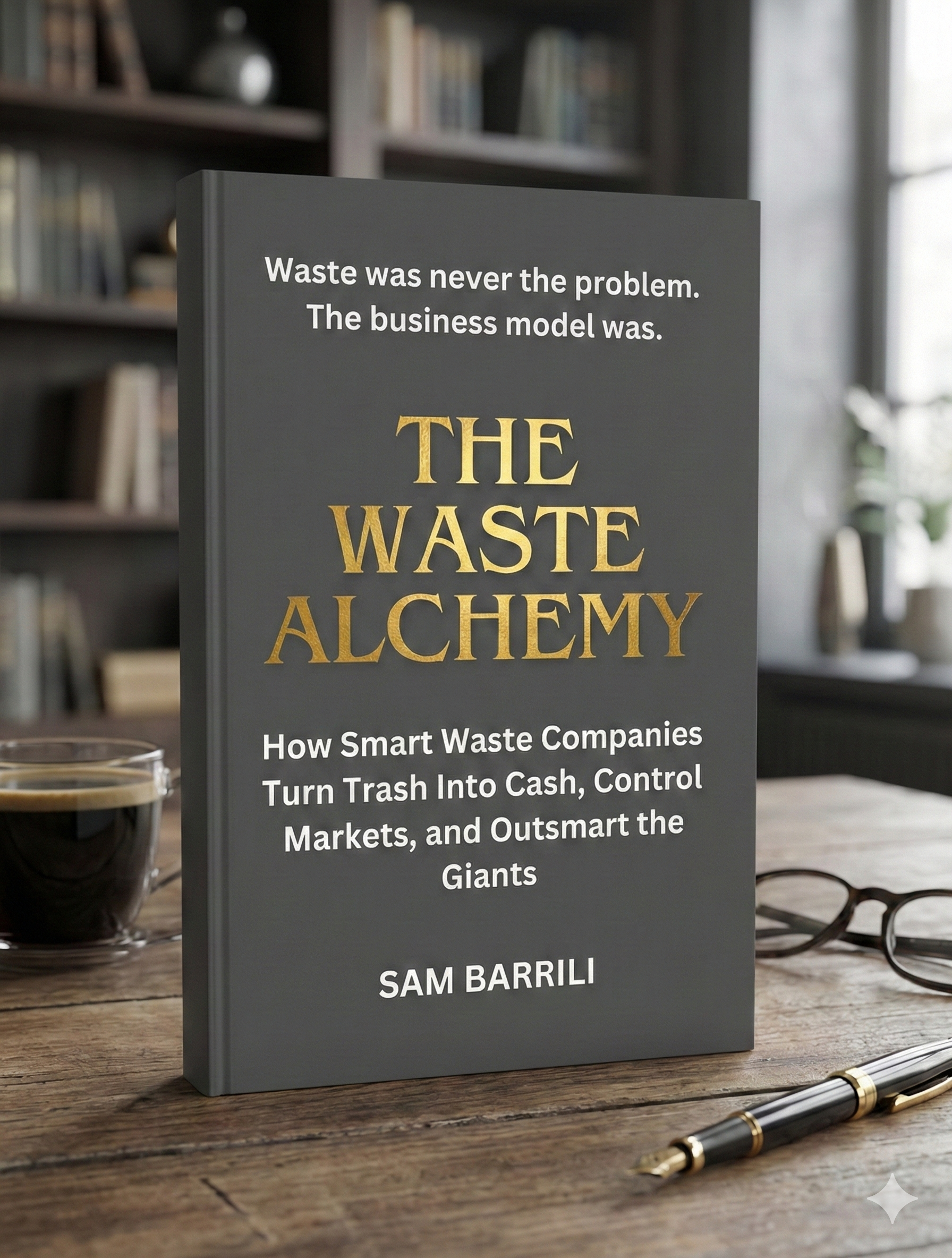
PS: If you want to learn how to transform your waste management company into a material provider, buy The Waste Alchemy by clicking HERE

© 2026 Marketing4waste - All Rights Reserved,
Marketing4Waste is a brand of MiM MarketingInterimManagers LLC
+1 801 804 5730