Increase the Revenues of Your Waste Company With the Tips Shared in Our Blog Articles
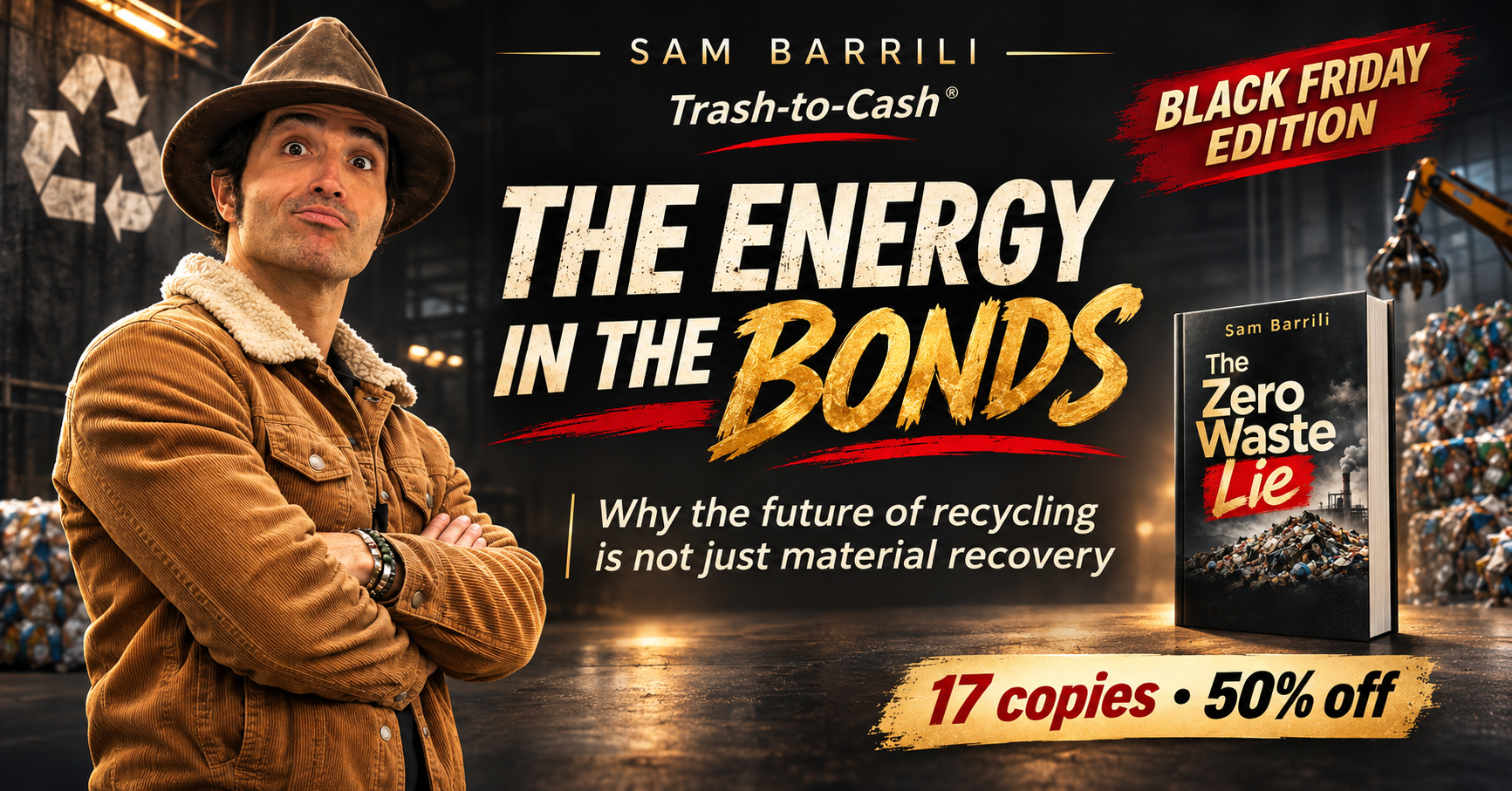
The Energy in the Bonds
I didn’t forget about you yesterday.
I made a choice.
I spent Thanksgiving with the people who matter to me. Away from my computer, away from this newsletter, away from the constant noise of our industry.
I’m glad I did.
Because today, on Black Friday, I’m back with something worth far more than another recycled conversation about recycling.
Thanksgiving is the one day most of us stop and ask what is actually worth keeping.
Our industry should ask that question every day. Most of us never do.
When we recycle, what are we actually trying to preserve?
The material? The percentage in the annual report? The headline?
Or the value?
A conversation that started with sharps
I had an interesting meeting today. The subject was US medical waste: hospitals, surgery centers, physician offices, sharps, fluids, the whole chain.
We started with medical waste. We ended up talking about the future of the entire industry.
Three ideas came out of that hour. Each one costs operators money.
Idea one: the one-bucket promise
One story stuck with me. A medical waste company is shutting down its incinerator.
Their pitch had been simple. Throw everything in one container. Sharps, pathological, trace chemo. We’ll burn it all.
It worked as a sales message. It failed as an operating model. Maintenance costs climbed until the plant stopped making sense. Now they have to unwind years of sales and retrain every customer they signed.
This is what mixed streams do.
When you accept poorly segregated waste, you inherit complexity you never priced. More labor. More equipment. More treatment stages. More maintenance. More plant capacity eaten by material that should never have arrived together.
And one cost almost nobody tracks: water.
Mixed medical waste carries fluids and wet tissue straight into the thermal process. Every kilogram of water absorbs energy just to heat up and evaporate. That energy never becomes steam for a turbine or heat for your process.
You are paying to boil water.
The value is destroyed before the material reaches final treatment.
Idea two: the economics are decided before the truck arrives
We compared two models I’ve discussed with clients for years. In Germany, households sort into several containers. In Los Angeles, everything goes into one cart, and the operator is expected to fix it on the back end.
So the largest companies in America spend enormous capital on facilities built to separate what the customer mixed.
Follow the chain. Mixed input demands separation. Separation demands bigger buildings. Bigger buildings demand more energy. Every link lands on the operator’s P&L.
The cheapest separation you will ever pay for is the one your customer does before collection.
That’s why generator education is not a feel-good initiative. It’s an operating investment.
It isn’t free. In Italy, we’re testing source separation with one large hospital to measure the real impact stream by stream. Our costs went up first: more containers, more collections, more handling. I expect the return. I’ll show you the numbers when I have them, not before.
But a customer who knows how you need the waste is worth more than a customer who hands it over however they like.
Idea three: the turning point
Then the conversation went where I wanted it to go.
Every fraction in a medical waste container has a different energy profile. Gloves, gowns and drapes are largely plastics. Paper and textiles are cellulose. Fluids and tissue are mostly water. Needles are steel.
So the question is not only “what can I recover as material?”
It’s also “how much chemical energy does this stream carry, and what does it cost me to get it out?”
Here’s the chemistry, without the lab coat.
Combustion and other thermal conversions are chemical reactions. Breaking existing bonds takes energy. Forming new, more stable bonds, like those in carbon dioxide and water, releases energy. When the release exceeds the cost, the reaction is exothermic. You get net heat.
That’s what I mean by the energy in the bonds.
A polyethylene glove carries plenty of it. Water carries none you can use. It costs you energy. And you don’t recover a steel needle’s value by burning it. Metal value comes back as metal, through the right process, or not at all.
What you actually recover depends on composition, moisture, the conversion pathway and process efficiency. Moisture alone changes everything. In one system I’ve worked with, removing water took medical waste from roughly 7,000–8,000 kJ/kg to about 16,000–17,000 kJ/kg. Your stream will give you different numbers. You have to measure it.
The answer I got back was physics. Energy can’t be created or destroyed.
True. And that’s exactly why “saving energy” needs precision.
The First Law guarantees the energy goes somewhere. It doesn’t guarantee it goes anywhere useful. Energy spent evaporating water, or dumped as low-grade heat, still exists. It’s just worthless to you.
What we lose is the quality of energy. Engineers call it exergy. Intelligent recovery, of material or of energy, is about preserving that quality instead of degrading it.
That landed. The response was honest: nobody at that table had looked at it in those terms before, and it needed thinking through.
That’s not an endorsement, and I won’t dress it up as one. Autoclaves are still the workhorse of this sector: proven, but heavy on water and natural gas. Operators are watching pyrolysis and chemical treatment closely to see how they hold up over the next few years. So am I.
My view is that future plants will combine technologies, each assigned the fraction it handles best. That’s a direction, not a proven universal answer.
This is not “burn everything”
Sometimes material recovery is clearly the best answer. Clean metals. Many plastics. Even metal from treated sharps residue, where the process and the market allow it.
Sometimes material recovery consumes more energy, water, chemicals, labor and capital than the output is worth. Certain paint residues are a good example.
For those streams, energy recovery may create more useful value.
Medical waste adds a hard layer on top. Infectious risk, classification, emission limits and treatment rules decide which pathways are legal before economics gets a vote. Energy recovery and recycling are different technical and regulatory categories. Incineration, pyrolysis and other thermal processes have different outputs, efficiencies and permits.
My rule:
Recover the material when it creates the greatest defensible value.
Recover usable energy when that is the better pathway.
Never spend more resources than the process can justify.
You may be measuring the wrong thing
The wrong recovery strategy shows up everywhere except your dashboard. Higher operating costs. Unnecessary energy demand. Extra processing steps. Bigger maintenance bills. Lower effective capacity. Outputs nobody wants to buy. Opportunities you never saw.
Tons collected won’t show it. Recycling rate won’t show it.
As I said in that meeting: what we don’t measure, we don’t know. So measure this:
Saleable recovered material per ton
Net usable energy recovered
Energy and water consumed per ton
Processing cost per stream
Residual disposal requirements
Market value of outputs
Contribution margin after treatment and compliance costs
That’s the shift. From recycling percentages to recoverable resource value. From waste as a disposal problem to waste as a complex inventory of potential industrial resources.
Your problem may not be the waste you collect.
It may be your business model, and the way you evaluate that waste.
Why I wrote The Zero Waste Lie
This is the argument at the center of The Zero Waste Lie: Why the Laws of Physics — Not Marketing Hype — Should Run Your Waste Business.
The book is not anti-recycling. It is not anti-environment.
It’s against something more expensive: targets and declarations treated as achievements, with nobody examining the actual resource flows and industrial outcomes behind them.
Zero Waste can work as an aspiration. It cannot mean every material is recoverable forever without losses. Every industrial transformation runs into practical and thermodynamic limits.
The real challenge isn’t a pretty headline or a perfect recycling percentage. It’s managing resources intelligently, conserving industrial value, and putting useful outputs back to work in the economy.
If this article made you uneasy about a number you’ve been proud of, the book goes much deeper.
For the people who keep reading
Yesterday, I chose to give my time to the people I care about.
Today, I want to give something back to the people who keep reading, questioning and challenging the conventional wisdom of this industry.
I’m making 17 copies of The Zero Waste Lie available at 50% off the regular price.
Not a storewide sale. Seventeen copies.
The offer closes Saturday, November 28, 2026, at 6:00 PM Eastern, or when the 17th copy is claimed, whichever comes first.
Mail me using: ZERO WASTE as the subject.
I’ll send purchase instructions in the order messages arrive, until the 17 copies are gone.
Energy is never destroyed.
Value is. Usually by someone who wasn’t measuring.
Sam
The Waste Management Alchemist

© 2026 Marketing4waste - All Rights Reserved,
Marketing4Waste is a brand of MiM MarketingInterimManagers LLC
+1 801 804 5730