Increase the Revenues of Your Waste Company With the Tips Shared in Our Blog Articles
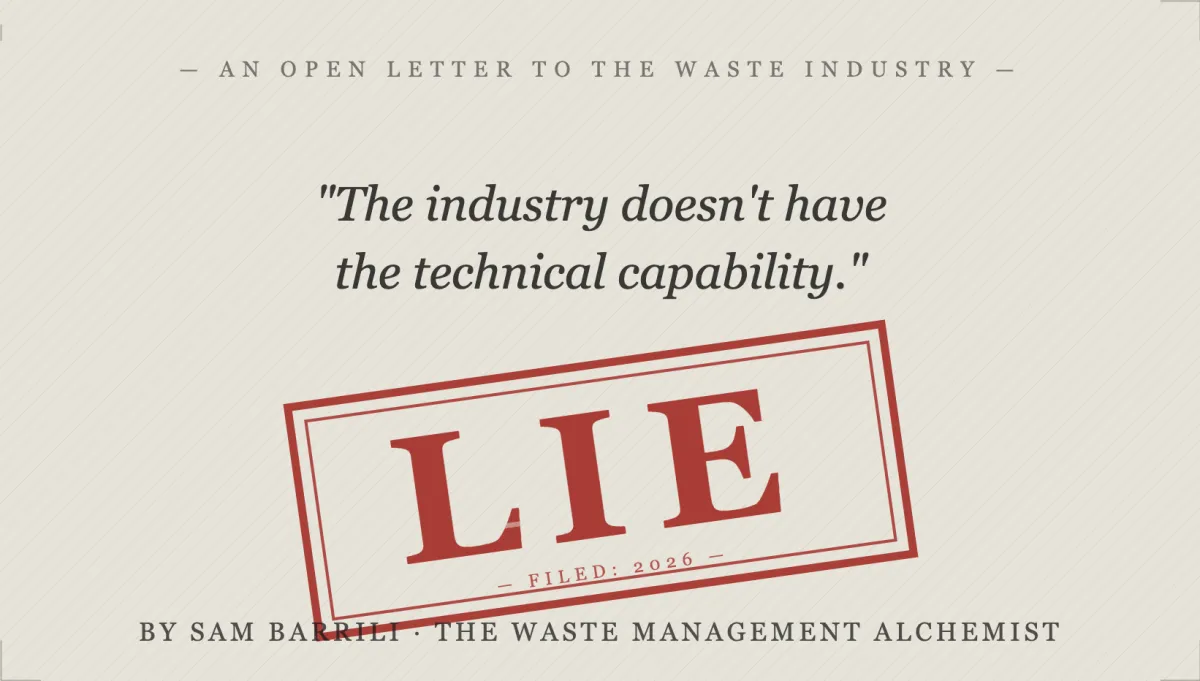
The Capability Lie That's Quietly Bankrupting Your Waste Company
(And What A Single Comment On One Of My Recent Posts Just Exposed About The Entire Industry)
So the other day I published a post on LinkedIn.
Nothing crazy. Just me saying what I've been saying for fifteen years.
That most waste companies are stuck on a treadmill of more trucks, more routes, more revenue — and no real margin, no real control, no real enterprise value.
That the whole game changes the moment you stop treating waste as something to move and start treating it as an asset to control.
Control the stream. Control the output. Control the margin.
The post did what these posts always do. Owners DMed me. Operators agreed. A few people pushed back.
And then a comment came in that I actually want to talk about.
It came from someone running a technology company in our sector. I'm not going to name them — it doesn't matter who they are, and honestly, the point I want to make isn't about them at all. It's about the sentence they wrote.
Because what they said is — without exaggeration — one of the most useful comments I've ever received on a public post.
Not because they agreed with me.
Because they walked straight into the exact mental trap that is keeping this entire industry small, scared, and underpaid.
Here's the core of what they wrote. I'm paraphrasing lightly:
"The model in most waste businesses is flawed across the value chain. Only a limited amount of waste can realistically be recycled, and beyond a certain volume it becomes impractical to eliminate or convert into end-product output. The industry currently does not have the technical capability to fully eradicate waste in a way that is cost-effective, economically viable, efficient, and environmentally sustainable."
Then — and this is the part you need to pay attention to —
"…but WE do."
And they went on to describe a proprietary conversion technology that can process almost every waste stream you can think of. Plastics. Diapers. Tires. Medical waste. Sewage. Contaminated water. All of it. Into hydrogen, clean diesel-equivalent fuel, and power. At below industry rates.
Now.
I want you to read those two statements again slowly. Because inside them is the entire disease of the modern waste industry, wrapped in a bow, handed to us on a plate.
And I'm going to break it down for you in a way that — if you actually run a waste company, a recycler, a hauler, a junk removal operation, a landfill, a transfer station, anything — will probably change the way you think about your business for the next ten years.
Let's go.
The Sentence That Should Make You Furious
Read this part again:
"The industry currently does not have the technical capability to fully eradicate waste in a way that is cost-effective, economically viable, efficient, and environmentally sustainable."
This is the sentence.
This is the exact sentence that is repeated, in one form or another, in every industry conference, every trade magazine, every government report, every "sustainability" panel, every EPR discussion, every consultant deck, every university lecture, and every boardroom in our sector.
And it is a lie.
Not a polite lie. Not a "well, it's complicated" lie.
It is a structural, profitable, deeply entrenched lie that benefits a very specific group of people — and costs you, the operator, millions of dollars in margin every single year.
Here's why.
The technology exists. It has existed for years. In some cases, decades.
Hydro-steam gasification? Exists.
Pyrolysis? Exists. I'm personally supporting a pyrolysis project in Sarno, Italy right now with the Agovino Group.
Advanced e-waste recovery that pulls critical raw materials back out of the stream? Exists. I'm building one in Castelo Branco, Portugal.
Landfill mining that turns a closed landfill into an actual mine for metals, plastics, and refuse-derived fuel? Exists. We're developing one in Angola.
Chemical recycling. Molecular recycling. Advanced sorting with AI. Hydrothermal liquefaction. Plasma gasification. Solvent-based purification. Cryogenic separation.
All of it exists.
So when someone says "the industry doesn't have the technical capability," what they are actually saying — whether they realize it or not — is:
"The industry has chosen not to adopt it."
And there is a gigantic difference between those two statements.
Why The Industry "Chooses" Not To Adopt It
Now here's where it gets uncomfortable.
Because I'm going to tell you the truth, and the truth is going to sting a little bit if you're running a traditional hauling business.
The industry hasn't adopted these technologies because the industry doesn't make money from solving the waste problem.
It makes money from managing the waste problem.
Those are two completely different business models.
Managing the problem means:
More trucks
More routes
More tipping fees
More volume
More tonnage
More contracts
More landfill airspace sold at a premium
Solving the problem means:
Fewer tons going to disposal
More material converted into something valuable
Higher margin per ton
Revenue decoupled from volume
Dependence on commodity markets instead of disposal markets
Can you see the problem?
The entire financial architecture of the mainstream waste industry — the public companies, the private equity roll-ups, the municipal contracts, the vertically integrated giants — is built on the assumption that waste will keep flowing and disposal will keep being the default answer.
If gasification works. If pyrolysis works. If landfill mining works. If advanced recovery works.
Then the landfill isn't a cash cow anymore. The transfer station isn't a moat anymore. The long-term municipal contract isn't a guaranteed annuity anymore.
The game changes.
And the people who currently sit at the top of the game really, really don't want the game to change.
So what do they do?
They repeat the sentence.
"The industry doesn't have the technical capability."
And it trickles down. Into associations. Into magazines. Into your head. Into the head of the guy running a 12-truck operation in Ohio who reads this stuff and thinks — "well, I guess there's nothing I can do except add another truck."
That's the lie.
Now Let's Talk About The Second Law Of Thermodynamics
Because I already hear some of you typing.
"Sam, but you can't eradicate waste. Entropy. Second law of thermodynamics. You've literally written about this. The asymptotic limit of circularity is real."
Yes. It's real. I've built a significant part of my intellectual framework around it.
And this is exactly where the comment I received gets interesting. Because the person who wrote it is half right and half making the same mistake as everyone else.
They're right that there is no magical 100% elimination. The second law is not negotiable. You cannot run a perfect circular economy. You will always lose some energy, some material, some quality to entropy. That's why the whole "zero waste" ideology is fundamentally unscientific and, frankly, a form of religious belief dressed up in sustainability language.
But — and this is the part that matters for your business —
Between the current industry average of "dig a hole and bury it" and the theoretical limit imposed by thermodynamics, there is an enormous, embarrassing, multi-billion dollar gap.
And that gap is where the real money is.
That gap contains:
The plastics that are currently landfilled because "we can't recycle them" — but can actually be gasified, pyrolyzed, or chemically recycled
The tires that are currently stockpiled because "there's no market" — but can be converted into carbon black, steel, and fuel oil
The medical waste that is currently incinerated at $2 per pound because "it's hazardous" — but can be sterilized and processed
The e-waste that is currently shipped to landfills in developing countries because "it's too complicated" — but contains gold, silver, palladium, copper, cobalt, and rare earth elements at concentrations higher than virgin ore
The food waste that is currently rotting in landfills producing methane because "composting is expensive" — but can be turned into biogas, nutrients, or animal feed
The construction debris that is currently crushed into the cheapest possible aggregate because "there's no value" — but contains recoverable metals, engineered wood products, and sortable fines
Every single one of these streams has a technology that can do something better with it than landfilling.
Every. Single. One.
And every single one is being landfilled at scale in 2026 because the industry financial model rewards landfilling, not recovery.
This isn't a capability problem.
This is a positioning problem.
This is a business model problem.
This is an ownership problem.
What That Comment Actually Exposed (Without Meaning To)
Here's the part of the comment that I actually loved.
Because after writing "the industry doesn't have the capability," the same person wrote — "but WE do."
And they're probably right. I haven't audited their technology. I'm not going to vouch for their specific numbers. But the broader claim — that there are companies right now, operating today, that can process waste streams the mainstream industry considers impossible — is absolutely true.
There are dozens of them. Maybe hundreds.
Some are real. Some are vaporware. Some are over-promising. Some are actually quietly crushing it with no press.
But the fact that any of them exist — and can demonstrate results — completely destroys the "we don't have the capability" narrative.
So the real question isn't "does the technology exist?"
The real question is:
Why aren't you using it?
And the answer for 95% of waste company owners is going to be uncomfortable. Because the answer is usually some version of:
"I didn't know it existed."
"It's too expensive for my size."
"My customers won't pay for it."
"My municipality doesn't require it."
"My competitors aren't doing it."
"I'd have to change how I operate."
"I make money the way I make money."
Every one of those answers is a business decision. Not a technical limitation.
And that's the whole point of everything I teach.
The Shift: From Hauler To Material Provider
I want you to sit with this for a second.
If you run a waste company today, you are almost certainly positioned as a hauler. Even if you don't call yourself that. Even if you own a transfer station or a MRF or a landfill.
Your customers pay you to make waste disappear.
Your revenue is tied to trucks, routes, tons, and tipping fees.
Your margin is compressed by fuel, labor, equipment, and disposal costs.
Your competitive advantage is "we show up on time and our guys are nice."
That's the hauler model.
And that's the model that is dying.
Not because waste is going away. Waste isn't going away. The volume is going up, not down.
But because the value chain is reorganizing underneath your feet.
The manufacturers who used to pay virgin-material prices for their inputs? They are now — right now, today, as you read this — paying premium prices for recovered secondary raw materials. Because of critical mineral restrictions. Because of ESG pressure. Because of geopolitical supply chain risk. Because of tariffs. Because of export bans from China and Indonesia and the DRC.
The auto industry wants recovered aluminum and copper.
The electronics industry wants recovered rare earths, gold, palladium, and cobalt.
The plastics industry wants recovered polymer pellets that meet spec.
The energy industry wants refuse-derived fuel, syngas, and hydrogen from waste.
Every one of these industries is willing to pay — and paying — above commodity prices for clean, consistent, traceable secondary raw materials.
And where do those secondary raw materials come from?
They come from the piles of "worthless" material sitting in your yard right now.
They come from the contracts you are currently paying a landfill to take.
They come from the streams you are currently calling "waste."
This is the shift.
You are not a hauler. You are — or you could be — a material provider.
And a material provider operates on a completely different business model than a hauler.
You don't compete on route density. You compete on material quality.
You don't get paid by the ton coming in. You get paid by the ton coming out.
You don't beg for municipal contracts. You negotiate offtake agreements with manufacturers.
You don't worry about disposal costs. You monetize the disposal streams.
You don't lose sleep over tipping fees. You stack revenue per ton.
This is what I meant in the original post when I said: control the stream, control the output, control the margin.
So What Do You Actually Do On Monday Morning?
Because I don't want to leave you with philosophy. Philosophy doesn't pay payroll.
Here's what I'd tell you if you were sitting in front of me right now.
First. Stop defending the sentence. Stop letting anyone in your company — or your industry associations, or your sales team, or your own head — repeat the line that "we don't have the capability." It's not true. It was never true. And every time you repeat it, you give yourself permission to stay small.
Second. Audit your streams. Actually look at what is flowing through your operation. Not in tons. In materials. What polymer grades are you collecting? What metal alloys? What electronic components? What organic fractions? What hazardous categories? What contamination levels? Most waste companies have no idea what they actually handle, because they've been measuring in trucks and tons instead of materials and grades.
Third. Find your buyers before you find your technology. This is the part nobody tells you. You don't need to own a gasification plant. You don't need to build a pyrolysis facility. You need to identify who wants the outputs of those facilities — and start structuring your streams to feed them. The technology providers will find you once they know you have qualified volume.
Fourth. Kill the hauler mindset in your pricing. Stop quoting by the pull. Start quoting by the value you preserve. If you can deliver 20 tons of clean sorted PE film instead of 20 tons of mixed plastic going to landfill, that's not the same service. Don't price it like it is.
Fifth. Pick one stream. Just one. Don't try to transform the whole company at once. Pick the stream with the highest margin differential between disposal and recovery, and build a pilot around it. Prove it in twelve months. Then scale.
That's it. That's the whole playbook.
It's not complicated. It's just different from what the industry has trained you to do.
One Last Thing
When that comment came in, I don't think the person who wrote it realized they were handing me a gift.
They were trying to position their technology. Good for them — they should. If it works, the market deserves to know.
But what they actually did — in the same comment — was prove the entire thesis I've been building for fifteen years.
The industry doesn't lack capability.
The industry lacks owners who are willing to stop playing the hauler game and start playing the material game.
Those owners are rare. They're getting rarer in some ways and more valuable in others. Because the ones who make the shift early are going to own the next decade of this industry.
And the ones who keep repeating "we don't have the capability" are going to be bought, merged, or buried by the ones who do.
Your choice.
If you want to see what this shift actually looks like — the operating system, the frameworks, the pricing architecture, the buyer relationships, the stream audits, all of it — that's exactly what I've been quietly building inside Modern Waste Companies.
It's not for everyone. It's for the owners who are ready to stop defending the old model and start building the new one.
More soon.
Sam Barrili
The Waste Management Alchemist
P.S. If you want to argue with this article, good. Argue with it. But before you type the rebuttal, answer one question honestly: if the capability really doesn't exist, why do the people selling it say they have it? And if it does exist — what's your excuse?

© 2026 Marketing4waste - All Rights Reserved,
Marketing4Waste is a brand of MiM MarketingInterimManagers LLC
+1 801 804 5730