Increase the Revenues of Your Waste Company With the Tips Shared in Our Blog Articles
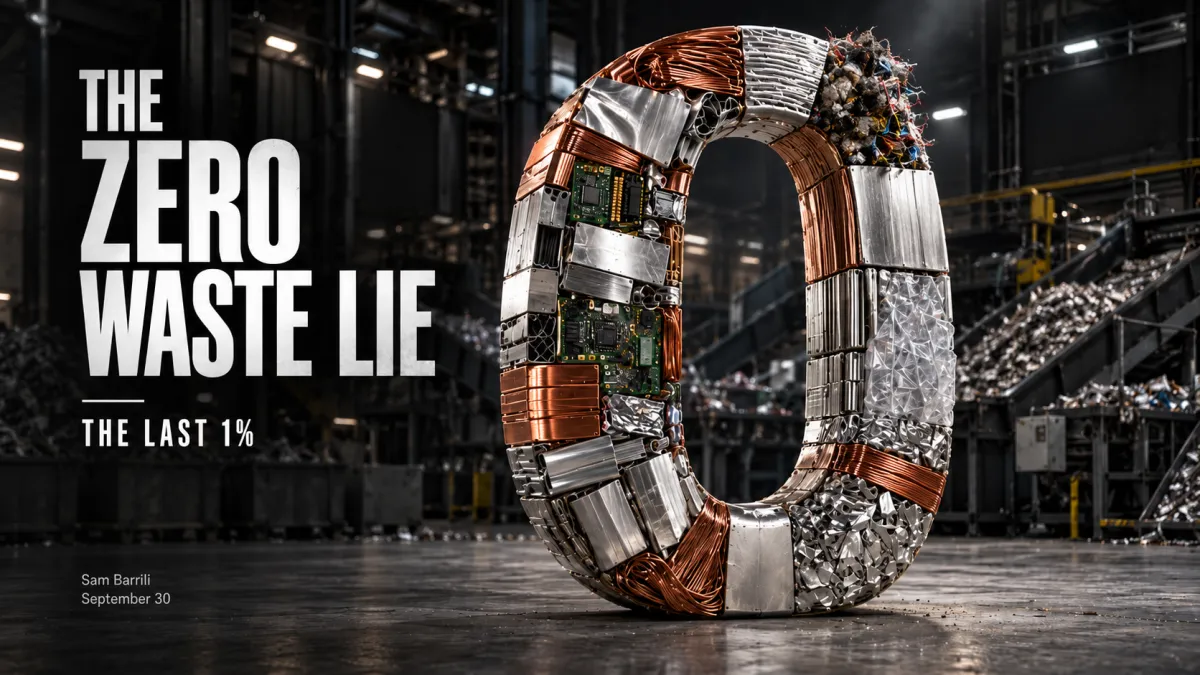
The Last 1%: Where Zero Waste Quietly Breaks
Why the final fractions of a waste stream can cost more to recover than everything that came before them.
Picture a plant that has already done its job well.
The metals are separated. The plastics are recovered and baled. The reusable components have been pulled and sold. Every fraction with a buyer, a spec, and a margin has been extracted.
What's left is a small, heterogeneous residual. Mixed. Contaminated. Bonded. The stuff that doesn't sort cleanly into any category and that no manufacturer is waiting to purchase.
Now the real question arrives — and it's not an environmental question. It's an engineering and accounting question:
How much energy, equipment, chemistry, transport, labor, and capital should a company spend to recover that last fraction — so someone can write the words "Zero Waste" in a sustainability report?
Hold that question. It's the whole argument.
I want to be precise about what I'm challenging, because this gets misread within about ten seconds if I'm not.
I am not arguing against recycling.
I am not arguing against waste reduction.
I am not arguing that industry should landfill more.
Reducing waste is rational. Recovering valuable materials is rational. Raising resource productivity is rational. Returning secondary raw materials into manufacturing is one of the most rational things the industrial economy can do.
The lie isn't recycling.
The lie is the target.
It's the quiet decision — made in policy documents, corporate pledges, and marketing decks — that success in waste management should be measured by proximity to zero. That "closer to zero" is automatically "better." That the empty bin is the goal.
That single choice of metric has bent an entire industry toward a number that physics, chemistry, and economics all treat with suspicion.
The 100% problem
Here's the part almost nobody says out loud.
Getting from a landfill-everything baseline to high recovery is a genuinely good business. The materials are concentrated, identifiable, and saleable. Each ton you divert pays for itself, often several times over. This is the part of the curve where recycling and recovery are obviously correct, and I'll defend it against anyone.
But recovery doesn't scale linearly. As you push toward totality, the material you're chasing changes character. It gets more dispersed, more mixed, more degraded, and less valuable — at exactly the moment it gets harder and more expensive to touch.
You've seen an asymptote even if you've never called it that.
You keep getting closer to zero.
Closer.
Closer.
And every additional step closer costs more than the step before it.
You can spend enormous effort and get from "a lot recovered" to "almost everything recovered." But "almost everything" and "everything" are not the same destination — and the distance between them is not a small last push. It's a cliff of cost disguised as a final step.
If this is already making you question what "zero" actually means inside an industrial system, I'm developing the full argument in The Zero Waste Lie. You can join the private September 29 release list here: https://sambarrili.com/zerowastelieprelaunch
Why the last fractions are a different animal
The first tons you recover and the last tons you chase are not the same material problem. Four things change as you approach the limit.
Dispersion. Early recovery deals with concentrated streams — a bale of one polymer, a pile of one metal. The final fractions are the opposite: tiny quantities of many materials, finely intermixed, sometimes chemically bonded. Separating dispersed material always costs more than separating concentrated material. Always.
Composites and multi-material design. Modern products are engineered for performance, not for disassembly. Laminates, coatings, fillers, adhesives, and layered packaging are built to not come apart. Recovering the materials inside them means fighting the product's own design.
Contamination. The residual fraction is where the contamination concentrates. Food, moisture, dirt, mixed polymers, and cross-material fragments all end up here. Contamination is the single most reliable destroyer of recovered-material value, and it's densest exactly where "zero" wants you to keep working.
Degradation. Materials are not immortal. Metals like aluminum tolerate repeated cycles well. Most polymers do not — chains shorten, properties fall, and each loop lowers the grade. At some point the recovered material simply can't meet the specification the market requires, no matter how clean your process is.
The floor and the wall
Now to the physics — and here I want to correct a mistake I hear constantly, including from people who agree with me.
People reach for thermodynamics to argue that high recovery is impossible. That's wrong, and it's worth getting right, because the sloppy version of this argument is easy to demolish.
The second law does set a hard floor: perfectly separating a fully mixed system requires energy, and driving the last traces of separation toward completeness sends that energy requirement toward infinity. Mixing is easy and free. Un-mixing is neither. This is why literal, absolute, 100.000% recovery is not a demanding target — it's a physically incoherent one. Zero residual is the industrial equivalent of absolute zero temperature: you can approach it forever and never arrive, and each increment closer costs disproportionately more.
So thermodynamics kills the absolute. Good. But that's the floor, and the floor is far, far below where any real plant operates.
The reason we don't recover the last fractions isn't that physics forbids it. Physics permits far more recovery than we actually achieve. The wall we hit first is not thermodynamic. It's economic.
Long before you reach any physical limit, you reach the point where the energy, reagents, labor, and equipment needed to recover one more ton cost more than that ton will ever be worth — and where the material you'd recover is too degraded or too contaminated to sell at all. That's the wall. It arrives early, and it's made of money and quality, not entropy.
Confusing the floor with the wall is how smart people lose this argument. The floor says zero is impossible. The wall says chasing it is irrational. Two different statements. Both true. Only the second one runs your business.
The residue that recovery creates
There's a recursive problem hiding underneath all of this, and it's the one I find people most rarely think through.
Recovery processes are not clean. Sorting, washing, shredding, melting, and chemical treatment all consume resources — and all generate their own residues. Wash water. Reject streams. Filter cake. Off-spec output. Process losses.
So as you chase the final fraction of the original waste, your recovery process produces a new fraction of waste. You don't reach zero. You relocate it — into a different stream, in a different place, on a different line of the ledger.
At the extreme, you can burn more resources recovering a marginal material than that material saves by not being virgin. That's not sustainability. That's a rounding error dressed as a principle.
Technically recoverable is not economically recoverable
This is the distinction the word "zero" erases, and it's the most important one in the whole discussion.
Almost anything is technically recoverable. With enough energy, enough reagent, and enough money, you can pull nearly any element out of nearly any mixture. Laboratories do it every day.
Economically recoverable is a completely different set. It's the subset where the recovered material clears three tests at once: it can be produced at a cost below its market value, at a purity a manufacturer will actually accept, for a buyer who actually exists.
"Zero waste" quietly assumes those two sets are the same. They are not, and the gap between them is where fortunes and credibility get lost.
And there's a trap even inside the "recovered" number: downcycling is not reintegration. Turning a high-grade material into a lower-grade filler counts as "recovered" in the statistics, but it doesn't return that material to its original function. It's a slower path to disposal, not a closed loop. A high recovery rate can hide a low reintegration rate — and reintegration is the thing that actually displaces virgin resource extraction.
The question nobody asks
So here's the uncomfortable one.
What if "how close to zero did we get" is simply the wrong thing to measure?
It feels right. It's simple, it's directional, it fits on a slide. But a metric that pushes you toward a physically incoherent target, past the point of economic and energetic rationality, isn't measuring success. It's measuring obedience to a slogan.
What would we measure instead if we were being serious?
Not the emptiness of the bin. The resources inside it.
Which natural resources does this material actually contain?
Which of them can realistically be recovered — at what purity, at what energy cost, at what economic cost?
Who needs those secondary raw materials, and can they genuinely replace virgin resources in manufacturing?
What fraction should be recovered — and what fraction is, with today's technology, irrational to chase?
Notice what happens when you ask those questions. The goal stops being the absence of waste and becomes the presence of recovered value. You stop optimizing a bin and start managing a resource.
From waste management to resource management
This is the shift I think the industry has to make, and it's bigger than a change in vocabulary.
For a century, this sector was organized around a problem: material nobody wanted, that had to go somewhere. "Zero waste" is the most ambitious possible version of that same old framing — it still defines success by the disappearance of the unwanted.
But the material in that residual stream isn't unwanted in any deep sense. It's natural resources — metals, polymers, carbon, energy content — that were extracted from the earth at real cost and are now sitting in a mixed pile. The strategic question was never "can we make the pile disappear." It's "which of these resources is it rational to reclaim, at what grade, for whom, and at what point does reclaiming the rest cost more than it returns."
That is a resource-management question, not a waste-management question. And the company that learns to ask it — that can tell you exactly where its own recovery curve stops being profitable and why — is operating on a different level than the company still chasing an empty bin for a report.
I'm not going to lay out the full model here. The metric that replaces "zero," and the method for finding the rational stopping point in your own streams, is the spine of the book. But the door it opens is this: the moment you stop treating zero as the goal, a set of much better questions becomes available — and most of them are worth money.
The Zero Waste Lie
That's what the book is about.
The Zero Waste Lie challenges the assumption that waste-management success should be measured by proximity to zero — and argues for a different model built around natural resources, material value, recovery, secondary raw materials, real industrial demand, the technology that actually exists, and the physical and economic constraints that don't care about our targets.
It's not an argument against recovery. It's an argument for better mathematics — for measuring resource recovery, quality, reintegration, and economic value instead of worshipping a number that physics won't grant and economics won't fund.
You should be able to disagree with my conclusion and still concede the argument is serious. That's the standard I've held myself to. If it doesn't clear that bar, I haven't done my job.
Join the priority list
The Zero Waste Lie releases publicly on September 30.
On September 29 — one day before the public announcement — I'll contact the people who joined my private pre-launch list first.
There is nothing to buy today. No payment. No obligation. Registering just tells me one thing:
"Sam, this argument interests me. Let me know when the book is available."
If that's you, join the priority list here:
https://sambarrili.com/zerowastelieprelaunch
You don't have to agree with The Zero Waste Lie yet.
You only have to be curious enough to examine the evidence.
To Your Success
Sam Barrili
The Waste Management Alchemist

© 2026 Marketing4waste - All Rights Reserved,
Marketing4Waste is a brand of MiM MarketingInterimManagers LLC
+1 801 804 5730