Increase the Revenues of Your Waste Company With the Tips Shared in Our Blog Articles
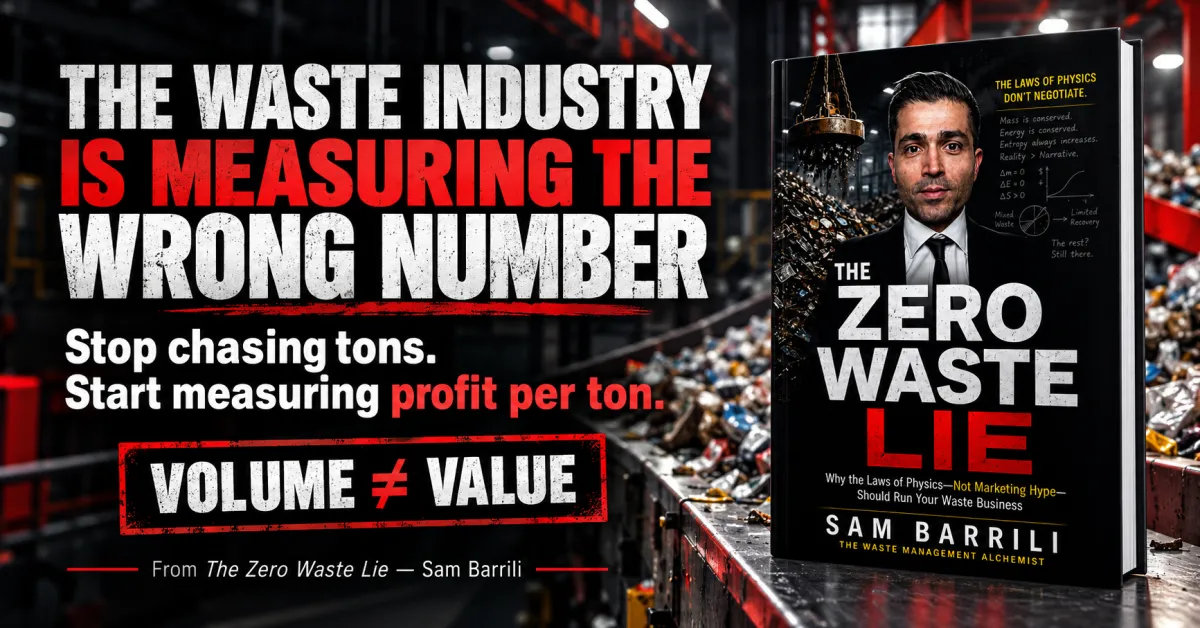
The Waste Industry Is Measuring the Wrong Number
What if the waste industry has spent the last thirty years optimizing the wrong number?
We celebrate diversion percentages.
We celebrate tons recycled.
We celebrate bigger fleets, new routes, and the latest sorting machine on the tipping floor.
Now walk into any of those companies and ask the owner one question:
How much profit do you make on every ton of material that passes through your hands?
I don't mean revenue, tons per month, or trucks on the road. I mean profit, per ton.
Most can't answer it. I know because I've been asking it for fifteen years, in yards across the United States, Europe, and Africa. The ones who can't answer are usually the ones working seventy-hour weeks, adding a ninth truck, and wondering why the bank account doesn't grow with the fleet.
The industry's two favorite numbers, diversion rate and tonnage, share one flaw. They measure activity, not value. One promises to eliminate waste. The other promises growth. Neither tells you whether the business is making money.
So here is my position, and I'll defend it with chemistry, physics, and arithmetic rather than slogans:
The waste industry has spent decades trying to eliminate waste, when it should have been learning how to extract maximum economic value from materials.
Those are not the same goal. Past a certain point, they pull in opposite directions.
The Physics Nobody Can Negotiate With
I'm a chemist before I'm anything else in this business, so let me start where chemistry starts.
In 1789, Antoine Lavoisier showed that matter is never destroyed. It only changes form. Nothing is lost, nothing is created, everything is transformed.
Think about what that means for your operation. When your driver dumps a load at the landfill, nothing disappears. Every atom of steel, copper, cellulose, and polymer is still there. "Disposal" is a polite word for relocation. You moved the atoms somewhere else and stopped tracking them.
That's the good news. The value in your material never vanishes.
The bad news comes from the Second Law of Thermodynamics.
Take a jar of white sand and a jar of black sand, pour both into a bucket, and stir. Mixing takes three seconds. Separating them again, grain by grain, could take days.
Mixing is easy and happens on its own. Separation is hard and always costs energy, labor, and money. Physicists call the disorder of a mixture entropy.
Operators call it other things:
Contamination. Mixed loads. Residuals. "The stuff we can't sort out." The reason the recycling rate never hits what the municipality promised.
Every one of those is entropy.
When a pizza box lands in the cardboard container, grease migrates into the fibers. The atoms are still there, but the order is gone, and restoring it costs more than the cardboard is worth.
Every time you push disordered material back toward a usable state by sorting, cleaning, melting, or re-extruding it, the universe charges a fee. I call it the heat tax. Even aluminum, the industry's favorite success story, pays it. Recycling aluminum takes a small fraction of the energy of primary production, but the cost is still above zero, and it rises the moment the aluminum is mixed, coated, or shredded into everything else.
You can't negotiate the heat tax, legislate it away, or buy a machine that repeals it.
The Last 1%
Here's where Zero Waste, as a literal target, runs into trouble.
Picture a jar with 100 marbles: 90 red and 10 blue. The blue ones are your recoverable material.
Your first grab pulls out five blue marbles. That's 50% recovery in three seconds.
The next grab gets three more, so you're at 80%, but it took longer because blue is now scarcer.
The ninth blue marble takes five grabs. The tenth takes dozens, and you end up examining every marble in the jar.
The effort didn't grow in a straight line. It curved, and it accelerated.
In the book, I formalize that curve as what I call the Asymptotic Effort Function:
E(R) = K / (1 – R)ⁿ
Here is what each part means in plain language:
E is the effort or energy you spend.
R is your recovery rate.
K is how complex the material is. A steel beam is low. A smartphone is extremely high.
n is how mixed and dispersed the material is.
Run simple illustrative numbers through it and watch what happens:
50% recovery: 20 units of effort
90% recovery: 100 units
99% recovery: 1,000 units
99.9% recovery: 10,000 units
100% recovery: division by zero, which means infinite effort
Each additional decimal place of recovery multiplies the cost. At 100%, the math breaks entirely.
This is the insight I want every operator to keep:
The last percentage points of recovery do not behave economically like the first percentage points.
Moving from poor recovery to good recovery can create enormous value. Moving from very high recovery toward 100% can demand disproportionately more energy, sorting, technology, labor, and capital, often to recover the lowest-value fractions in the stream.
Let me be precise about what I am not saying. I'm not saying recycling is pointless. Recovering materials is valuable. Reducing disposal is valuable, and pushing recovery higher is often valuable.
But valuable does not mean infinite. There are physical limits, economic limits, and quality limits.
The Operator Pays the Bill
Physics stays abstract until it reaches your P&L, so let's take it there.
Imagine a sorting operation handling 1,000 tons of mixed recyclables a month, where fully recovered material averages $100 per ton. These numbers are illustrative, but the shape of the curve is not.
At 50% recovery, processing is cheap and margin is strong.
Pushing to 75% still pays. The extra tons cost more to recover, but they're worth more than they cost.
At 90%, the incremental margin gets thin. You're chasing smaller pieces and dirtier fractions.
At 95%, the next 50 tons cost about $110 per ton to recover and sell for $100. You're now losing money on every ton your sustainability report calls "diverted."
At 99%, you're paying several times the material's value to capture it.
So the intelligent question for an operator isn't "How much can I divert?" It's this:
At what recovery point do I create the greatest combination of material value, economic return, and operational efficiency?
That point is an optimum, not a maximum. Finding it for your stream, in your geography, with your buyers, is the core strategic question of a modern waste business.
Volume ≠ Value
The same flaw that makes literal Zero Waste irrational shows up in how most companies grow.
The traditional model is simple: more customers, more trucks, more routes, more revenue.
But revenue scales in a straight line while costs don't. Your first five routes are dense and efficient. Routes eleven through fifteen stretch into thinner territory, with longer drives, more fuel per ton, and more overhead to coordinate. The fifteenth truck earns less than the fifth. Eventually the marginal truck adds revenue and zero profit.
Volume is a comfortable metric. It feels like growth and impresses your banker, and it can quietly eat your business.
Here's a comparison from the book. Again, it's illustrative, but every operator will recognize it:
Operator A runs eight trucks hauling mixed waste: around 30,000 tons a year and $2.4 million in revenue, netting roughly $10 per ton. A $5-per-ton gate fee increase wipes out half his profit.
Operator B runs three trucks focused on commercial cardboard and selective material recovery: around 4,500 tons a year and a fraction of the revenue, netting roughly $60 per ton.
Their total profits are in the same range. Operator A carries three and a half times the revenue to get there, plus twenty-two employees and full exposure to every diesel spike and gate fee increase. The same $5 increase costs Operator B a rounding error, because most of his tonnage never sees a landfill.
More trucks don't automatically make a better company. More tons don't automatically mean more profit, and higher diversion doesn't automatically mean better economics.
A smaller operator who deeply understands one material stream can create more value per ton than a larger operator who simply moves volume.
Tons collected is a number. Profit per ton is a strategy.
There Is No "Waste Stream"
The phrase "waste stream" itself is part of the problem.
A stream is something you stand beside and watch flow past, and that is exactly how most operators relate to their material: from customer to landfill, collecting a toll along the way.
But no single thing called "waste" exists. What moves through your trucks is a mixture of materials with different chemistry, different contamination tolerances, different buyers, and very different prices:
Copper. Aluminum. Steel. Cardboard. HDPE. PET. Electronic components. Valuable industrial residues.
Each behaves differently. PET melts at roughly 260°C and HDPE at roughly 130°C. Bale them together and the buyer gets two incompatible polymers that ruin each other in the melt. Clean and separate, each has a real market. Mixed, the bale trades at a fraction of either.
The material didn't change. The disorder did.
That's why the first question a serious operator asks isn't "Where do I dump this?" It's "What exactly is inside this?"
From Waste Collector to Material Company
Most small waste companies describe themselves the same way: "I collect waste."
There's another possible identity: "I control a stream of materials."
That change of language means a completely different business model.
The operator who controls a stream asks different questions:
What exactly is inside my stream?
What percentage can I realistically recover?
What does contamination do to its value?
Who buys this material, and what specification do they require?
What processing adds enough value to justify its cost?
What is my profit per ton?
This is the logic of the SAM Method, Stream Advanced Management, the framework at the center of the book.
It starts with a principle many operators find uncomfortable: One Stream. One Region. Total Dominance.
You don't serve everything for everyone. You choose one stream and one territory, and you set out to become the operator that every generator thinks of first and every buyer trusts most.
The physics backs this. Remember the n in the equation, the dispersion exponent? You can't change how complex a material is, because the manufacturer decided that. But you can change how mixed it is when it enters your system. Input Control, meaning what you accept, from whom, and in what condition, lowers n. A lower n flattens your cost curve and widens the zone where recovery pays.
Then comes Output Monetization: turning what leaves your yard into product rather than residue.
Finally, a point most operators never grasp: The Niche Is the Business Model. A niche isn't a label on your website. It decides your trucks, your processing, your buyers, your hiring, your pricing power, and what someone will pay for your company when you sell it.
What I'm not giving you here is the how: how to choose the stream, how to define the region, how to build the dominance position, and where most operators sabotage themselves in the first ninety days. That takes chapters, not paragraphs.
The Number I Want Operators to Start Measuring
If you take one thing from this article, take this.
Start measuring profit per ton.
Not revenue per truck, tons per month, or diversion rate.
Calculate profit per ton after fuel, labor, dump fees, equipment, insurance, overhead, and every other cost you carry. Then calculate it by route and by stream.
Profit per ton is the one number that can't hide anything. It absorbs contamination, freight, gate fees, buyer pricing, and the cost of chasing recovery past the point where it pays.
It also exposes a truth about contamination most operators learn the expensive way. Your buyer doesn't pay 95% of the clean price for 95% clean material. He pays a fraction of it, or rejects the load. Value doesn't decline in a straight line as contamination rises. It collapses.
Diversion rate can rise while profit per ton falls. Tonnage can grow while profit per ton shrinks. Profit per ton goes up only when you're doing something right.
Your Truck May Be Carrying Raw Materials
One more reframe, and it may be the most important.
"Scrap" sounds like something somebody wants to get rid of.
A secondary raw material is an industrial feedstock that somebody needs to buy.
The material is identical. The commercial relationship is entirely different.
A buyer of secondary raw materials thinks like any manufacturer buying any input. He cares about specification, consistency, contamination limits, and reliable supply. The operator who delivers on spec, every load, without surprises, stops being a seller the buyer tolerates and becomes a supplier he depends on. That's where premiums, contracts, and pricing power come from.
The path looks like this:
Waste collector → material processor → secondary raw material supplier.
Watch how differently each one handles the same phone call. A generator says: "Can you pick up my cardboard more often?"
The hauler hears more truck time and quotes a higher fee.
The supplier hears more feedstock and offers the extra pickups at no added charge, because the material is his real product. He keeps the account, increases his volume, and improves his margin. Same call, opposite outcome.
There's also a larger reason this matters. Manufacturers increasingly want reliable, domestic sources of metals, fiber, and polymers. The atoms they need are the same atoms riding in your trucks every day. In a sense, your truck is a periodic table on wheels.
The material already moving through your operation may be far more strategically important than you've realized.
Why I Wrote The Zero Waste Lie
This is why I wrote The Zero Waste Lie.
Despite the title, it isn't a book attacking Zero Waste as an aspiration. Ambition about reducing disposal is healthy. My objection is to treating a physically impossible endpoint as an operating target, and to the operators who pay for that confusion with their margins.
The book replaces that endpoint with something better: an operating system for waste companies built on:
physics
material knowledge
focus
economics
input control
output monetization
profit per ton
It walks from Lavoisier and the Second Law through the full math of the asymptote, into the forces that keep the volume model alive, and then through the complete SAM Method: how to choose your stream, define your region, control your input, build your buyer network, and turn your niche into a business that compounds.
The Zero Waste Lie is written for the operator who actually touches the material.
The person who drives the truck.
Runs the yard.
Sorts the load.
Negotiates with the buyer.
Makes payroll.
And carries the consequences when industry theories collide with operational reality.
One Thing to Do This Week
If you own or operate a waste company, I want you to do one thing this week.
Take your most important stream.
Forget the diversion percentage for ten minutes.
Calculate what that stream actually produces in profit per ton.
Then ask yourself:
Am I running a waste collection company…
or am I sitting on a raw-material business I haven't built yet?
If that question makes you uncomfortable, or curious, The Zero Waste Lie was written for you. It's available now:
And I want to hear from you; feel free to answer this email by clicking reply.
What metric matters most in your operation today: tons, diversion, revenue, or profit per ton?
To Your Success
Sam Barrili
The Waste Management Alchemist

© 2026 Marketing4waste - All Rights Reserved,
Marketing4Waste is a brand of MiM MarketingInterimManagers LLC
+1 801 804 5730