Increase the Revenues of Your Waste Company With the Tips Shared in Our Blog Articles
How to Transform Waste Streams Into Industrial Power - And Why The Waste Alchemy Is the Blueprint
There is a structural shift happening in the United States.
Manufacturing is reconfiguring its supply chains.
Energy systems are diversifying.
Critical raw materials are becoming strategic assets.
And secondary raw materials are no longer a side story.
They are infrastructure.
If you operate a waste management company, a recycling yard, a hauling business, a transfer station, or a landfill — you are not at the edge of this transformation.
You are sitting at the center of it.
But only if you understand how to map what you already handle.
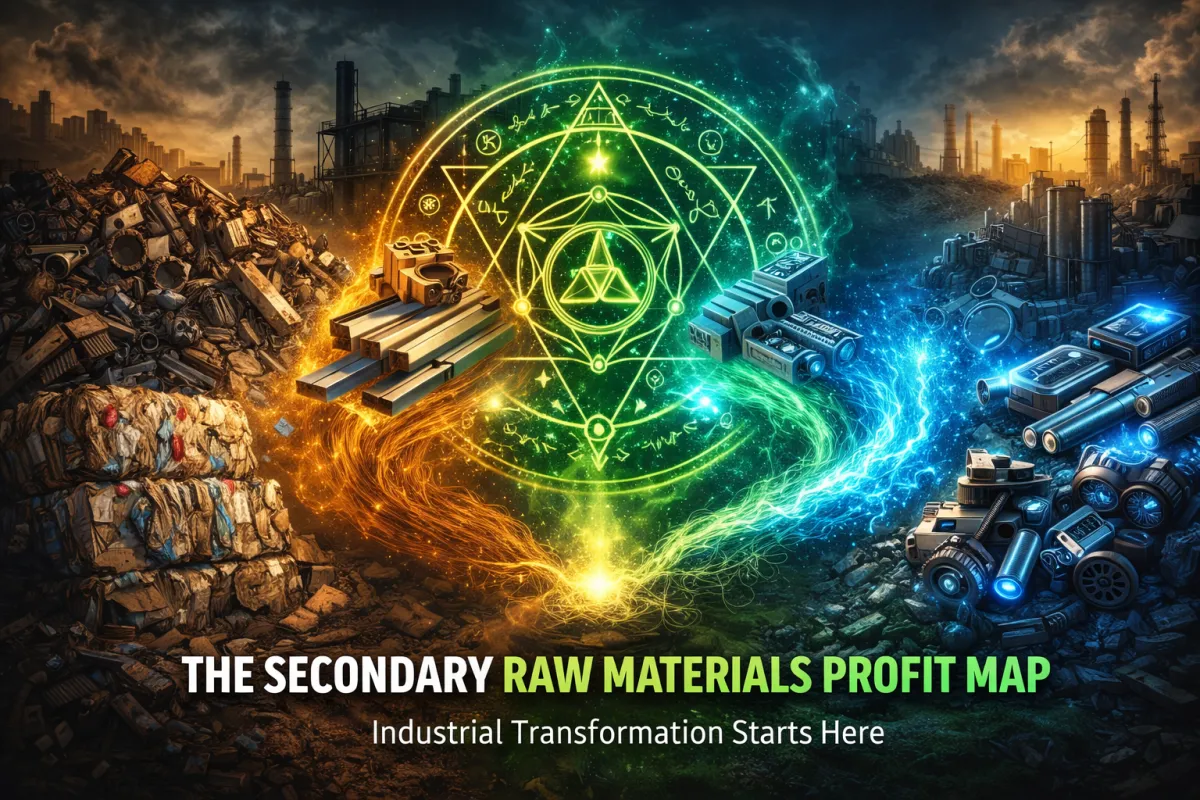
Today I want to walk you through the Secondary Raw Materials Profit Map — not as a slogan, but as a structured way to analyze your operation in relation to the size of the U.S. market and the industrial uses of each material.
And I’ll show you why The Waste Alchemy is the blueprint to turn this map into execution.
1. The Market Reality: Secondary Materials Are Industrial-Scale
Let’s start with scale — not emotion.
Metals
The U.S. uses over 60 million metric tons of steel scrap annually in electric arc furnaces.
Secondary aluminum production exceeds 3.5 million metric tons per year.
Copper scrap accounts for roughly one-third of domestic copper supply.
This is not niche recycling.
This is national industrial supply.
Steel production in the U.S. is now structurally dependent on scrap-fed furnaces. Entire production models are built around secondary inputs.
If you handle ferrous scrap and you think you're in "waste collection," you're misunderstanding your position in the value chain.
You are part of the steel energy system.
Paper & Cardboard
The U.S. recycles over 45 million tons of paper annually.
More than 30 million tons of recovered fiber are consumed by U.S. mills every year.
Cardboard recovery rates consistently hover around 70%.
Paper is not declining — it is evolving.
Beyond packaging, recovered cellulose fiber is now used for:
Molded fiber products
Biocomposites
Insulation materials
Textile fiber alternatives
We will come back to that.
Plastics
The U.S. generates tens of millions of tons of plastic waste annually.
PET recovery fluctuates around 30%.
Mechanical recycling is only part of the story.
The real expansion area is chemical recycling and alternative fuel production.
Critical Raw Materials
Battery materials, e-scrap components, industrial catalysts, rare earth elements — recycling of critical minerals is now a multi-billion-dollar domestic activity.
Policy, manufacturing reshoring, and EV adoption are accelerating the need for domestic secondary sources.
This is the environment in which your business operates.
Now let’s move from size to leverage.
At this point, you should feel something very specific.
Not excitement.
Responsibility.
Because if these are the industrial-scale numbers driving U.S. manufacturing — and your company is physically handling part of these streams — then you are already inside the supply chain.
The only question is whether you are operating with awareness.
This is exactly why I wrote The Waste Alchemy.
Not to explain recycling.
But to teach waste operators how to read the industrial landscape, identify where their streams fit, and restructure their business accordingly.
If you want to understand how to turn these macro-market dynamics into a practical transformation plan for your company, start there.
Because market size without a strategy is just information.
And information alone doesn’t change a balance sheet.
2. Paper & Cardboard: From Packaging to Textiles and Construction
Most operators see cardboard as packaging waste.
Manufacturers see cellulose fiber.
That difference in perspective defines profitability.
A. Textile Applications
Recycled paper and cardboard can be transformed into:
Regenerated cellulose fibers
Viscose-type materials
Lyocell-like fibers
Paper yarn textiles
Several startups and industrial groups are developing clothing made from wood pulp and recycled paper fibers.
The apparel industry is one of the largest industrial sectors in the world. Textile fiber demand exceeds 100 million tons globally each year.
If even a fraction shifts toward recycled cellulose-based fibers, recovered paper becomes a feedstock for clothing.
This changes the way you should think about:
Fiber purity
Contamination control
Sorting standards
Not as recycling metrics.
But as textile input standards.
B. Insulation & Construction Materials
Recycled cellulose is widely used for:
Blown-in insulation
Acoustic panels
Fiberboard
Composite panels
Construction in the U.S. is a multi-trillion-dollar sector.
Recovered fiber plays a role not only in packaging but in building envelopes and thermal efficiency systems.
Your cardboard is not waste.
It is structural material.
C. Molded Fiber and Packaging Substitution
Plastic bans in some regions are accelerating demand for molded fiber packaging.
Egg cartons were just the beginning.
Now:
Protective electronics packaging
Food containers
Industrial cushioning
Recovered fiber is becoming a substitute material for plastics.
That means quality consistency is critical.
3. Plastics: From Packaging to Energy & Hydrogen
Plastics are misunderstood.
Mechanical recycling tells only half the story.
A. Alternative Fuels
Plastic waste contains high calorific value.
Through pyrolysis and thermal conversion technologies, plastic can be transformed into:
Synthetic crude oil
Naphtha substitutes
Diesel-range hydrocarbons
The alternative fuels market is massive.
U.S. fuel consumption is measured in hundreds of billions of gallons annually.
Even marginal substitution through plastic-derived fuels represents large-scale industrial opportunity.
But this requires:
Clean feedstock streams
Controlled composition
Contracted supply
Mixed garbage is not feedstock.
Sorted polymers are.
B. Hydrogen Production
Emerging technologies are exploring plastic-to-hydrogen conversion through:
Pyrolysis reforming
Gasification processes
Catalytic conversion systems
Hydrogen is becoming a strategic energy vector in transportation and industry.
If plastic waste becomes part of hydrogen production chains, its strategic importance increases dramatically.
The operator who can guarantee consistent polymer supply will participate in that chain.
The operator who cannot… will landfill.
C. Circular Polymer Manufacturing
Chemical recycling allows depolymerization of:
PET into monomers
Polyolefins into feedstock hydrocarbons
This feeds back into virgin-grade plastic production.
The petrochemical industry is enormous.
If recycled polymers re-enter polymer production cycles at scale, plastic recovery becomes a feedstock market, not a disposal problem.
Here’s where most operators stop.
They see pyrolysis plants.
They hear about hydrogen.
They read headlines.
And then they do nothing.
Why?
Because they don’t have a framework to evaluate whether their material mix, sorting capacity, and positioning allow them to participate in these emerging value chains.
This is where The Waste Alchemy becomes essential.
Inside the book, I break down how to:
Evaluate whether a stream has upgrade potential.
Understand which downstream industries to target.
Avoid investing blindly in technology without securing supply contracts first.
Build leverage before capital expenditure.
If plastics are part of your operation, and you suspect there’s more value than you’re capturing, the book gives you the structured methodology to analyze that opportunity rationally — not emotionally.
Because industrial transformation rewards structure.
Not enthusiasm.
4. Iron & Steel: From Scrap to Energy Systems
Steel scrap is not just for new beams.
Electric arc furnaces (EAFs) use scrap to produce steel using electricity instead of blast furnace coke.
But there is another layer.
A. Thermal Energy Integration
Industrial scrap processing facilities generate heat.
Steel production facilities generate excess thermal energy.
In Europe, district heating systems use industrial waste heat to warm neighborhoods.
The U.S. is behind — but the model exists.
Scrap-fed steel production reduces dependence on primary ore and can integrate with energy grids.
If municipalities adopt district heating models:
Industrial waste heat
Scrap-based steel production
Urban heating systems
become interconnected.
That turns scrap from material input into part of a regional energy system.
B. Carbon Reduction Strategy
Steel production is carbon intensive.
Scrap-fed EAF steel significantly reduces emissions compared to virgin production.
As manufacturing companies pursue carbon reduction targets, secondary steel becomes strategic.
That increases long-term demand stability.
Which increases leverage for those who supply quality scrap.
5. Aluminum & Copper: Electrification Drivers
Electrification is expanding:
EV production
Grid expansion
Renewable energy installations
Aluminum and copper are foundational.
Secondary aluminum production saves enormous amounts of energy compared to primary smelting.
Copper scrap reduces dependency on mining.
These metals are not simply recyclable — they are energy leverage materials.
A waste company that isolates, upgrades, and understands these flows is operating within the electrification economy.
6. Critical Raw Materials: The Geopolitical Layer
Battery recycling capacity in the U.S. is expanding.
EV battery production requires:
Lithium
Cobalt
Nickel
Manganese
Recycling reduces import dependency.
Government incentives are pushing domestic recovery.
If your region has:
Auto dismantlers
Battery distributors
Electronics recyclers
You are sitting in proximity to strategic materials.
But only if you map them.
7. The Secondary Raw Materials Profit Map (Framework)
The map works through five analytical layers:
1. Volume Layer
What materials pass through your operation annually?
2. Upgrade Layer
What processing steps increase their industrial usability?
3. Application Layer
Which industries use these materials beyond their traditional applications?
4. Energy Integration Layer
Can the material participate in fuel, hydrogen, thermal, or energy systems?
5. Strategic Positioning Layer
Are you selling disposal… or are you supplying industry?
This is not about prices per ton.
It’s about aligning your operation with multi-billion-dollar industrial sectors.
Reading the map is one thing.
Implementing it is another.
Most waste management companies operate reactively — responding to customer calls, price swings, and regulatory updates.
The Secondary Raw Materials Profit Map requires proactive leadership.
You must:
Audit your streams.
Redesign internal processes.
Build new downstream relationships.
Train your team to think in specifications, not just loads.
That execution roadmap is precisely what The Waste Alchemy provides.
It is not a conceptual book.
It is a business transformation manual written specifically for waste management company owners who want to evolve beyond hauling margins.
If you recognize that your company is capable of more than service contracts…
Then you owe it to yourself to read the blueprint before your competitors do.
8. Why Most Operators Miss It
They are operationally efficient but strategically blind.
They measure:
Trucks
Drivers
Containers
Instead of:
Material composition
Downstream applications
Energy integration potential
Industrial demand shifts
They focus on service contracts.
Instead of supply contracts.
That difference defines margin structures.
9. Why The Waste Alchemy Is the Blueprint
The book is not a motivational narrative.
It is a structural guide.
Inside, I explain:
How to reframe waste streams as industrial streams.
How to analyze material composition.
How to reposition your business identity.
How to implement the SAM (Stream Advanced Management) Method.
How to create multiple revenue streams from the same tonnage.
The Secondary Raw Materials Profit Map shows you the landscape.
The Waste Alchemy shows you how to build roads inside it.
Without a system, you will see opportunity but fail to execute.
With a system, you can convert insight into structure.
10. The Real Question
You can continue operating as:
A service provider in a price-competitive hauling market.
Or you can evolve into:
A secondary raw materials supplier integrated with manufacturing, energy, textiles, and electrification.
Paper into clothing.
Plastics into fuels and hydrogen.
Iron into energy systems.
Metals into electrification.
Critical minerals into battery infrastructure.
This is not futuristic.
These applications already exist.
The only variable is whether you map your streams accordingly.
If you want the structured methodology to do it inside your company — not in theory, but in operations — start with The Waste Alchemy.
Because strategy without structure is noise.
And the next decade in waste management will reward structure.
The map is clear.
The blueprint is written.
The decision is yours.
To Your Success
Sam
The Waste Management Alchemist

© 2026 Marketing4waste - All Rights Reserved,
Marketing4Waste is a brand of MiM MarketingInterimManagers LLC
+1 801 804 5730