Increase the Revenues of Your Waste Company With the Tips Shared in Our Blog Articles
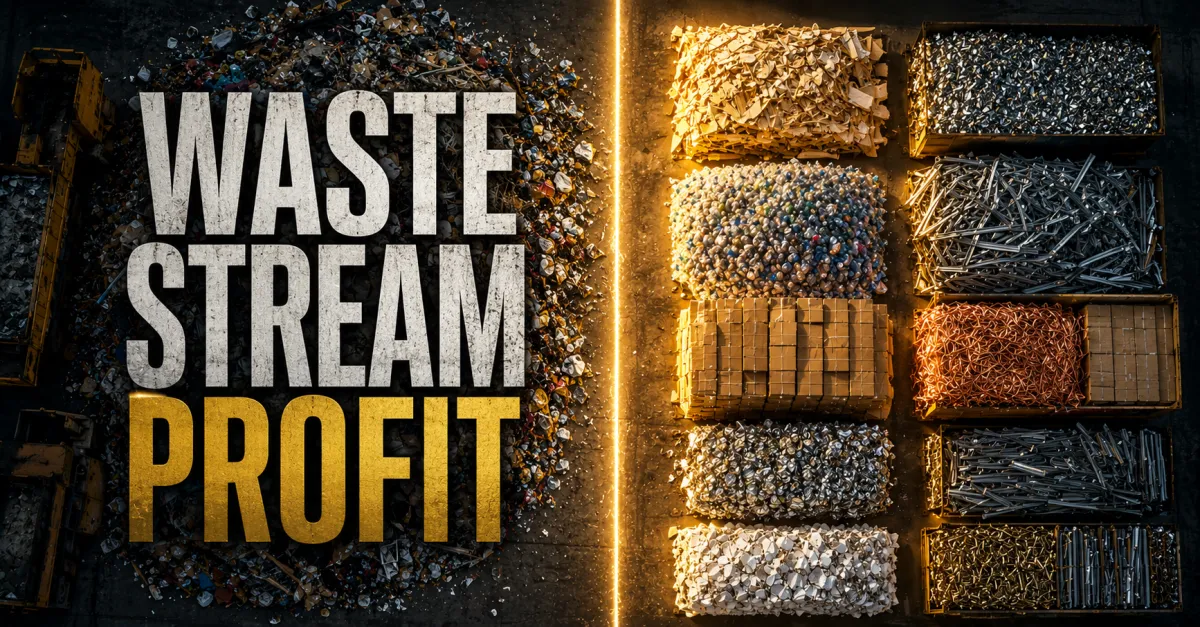
You're Throwing Away Money Every Single Day. Here's the Proof.
Let me tell you something that's going to bother you.
Right now, today, as you're reading this — material is leaving your yard that someone else is going to make money on.
Not a little money.
Real money. Recurring money. The kind of money that changes your margins, changes your cash flow, and changes the way you sleep at night.
And the worst part? You already have it. You're already touching it. You're already paying to move it.
You're just not seeing it for what it is.
I've spent 15+ years inside this industry, across four continents, working with waste operations of every size. And I can tell you with absolute certainty: the biggest profit leak in small waste management companies isn't inefficiency. It's misidentification.
You're looking at assets and calling them waste.
That single mistake is costing you more than any equipment upgrade, any new truck, or any marketing campaign ever will.
If you've ever felt like your margins are too thin for the volume you're moving — you're right. But the problem isn't the volume. The problem is what you're doing (or not doing) with what's already inside your operation.
I built the Waste Stream Profit Audit specifically for operators like you. 90 minutes. Your streams. Your numbers. Your money.
Book Your Waste Stream Profit Audit With Sam →
The Myth That's Bleeding You Dry
Here's what I hear from small waste management company owners almost every single week:
"Sam, I know there's probably value in what we're handling. But we don't have the infrastructure. We'd need new equipment. We'd need certifications. We'd need to build out a whole new process. It's too complicated for a company our size."
And every single time, I say the same thing:
No. You wouldn't.
That belief — that turning waste into revenue requires complex, capital-intensive processes — is the single most expensive myth in our industry.
For some streams? Sure. There's real infrastructure required.
But for a surprising number of streams that are already flowing through your operation, the process is laughably simple. We're talking about basic identification, basic separation, and a phone call to the right buyer.
That's it.
No new permits. No six-figure machinery investments. No complicated chemistry.
Just the decision to stop treating everything that leaves your yard as a cost — and start treating some of it as a product.
Let me show you what I mean. I'm going to walk you through three examples that I use with clients constantly, because they make the economics impossible to ignore.
Example 1: Non-Ferrous Metals — The Money You're Literally Burying in Mixed Loads
Let's start with the one that makes me lose sleep on behalf of operators who don't see it.
Non-ferrous metals.
Aluminum. Copper wire. Brass fittings. Stainless steel. These materials show up constantly in commercial and construction waste streams. They're in demolition debris. They're in cleanout jobs. They're mixed into loads that get hauled to the landfill or sent to a transfer station where someone else — someone who IS paying attention — pulls them out and sells them.
Here's the reality of non-ferrous metal pricing right now: copper is trading in the range of $4+ per pound. Aluminum is moving. Brass and stainless steel have strong, consistent demand from secondary smelters.
And what does it take to capture this value?
A magnet and a trained eye.
That's the "complicated process" that's standing between you and a new revenue line. Non-ferrous metals don't stick to a magnet. Ferrous metals do. Run a magnet over a mixed pile, and whatever doesn't stick is where the money is hiding.
You don't need a shredder. You don't need an eddy current separator (not at this scale). You don't need a metallurgy degree. You need a guy on your crew who knows the difference between aluminum and steel, a couple of bins, and a relationship with a local scrap dealer.
I've seen small operators add $3,000 to $8,000 per month — net — just by pulling non-ferrous out of loads they were already handling. No new customers. No new routes. No new trucks. Just one decision: stop letting value leave your yard unidentified.
Now multiply that across 12 months.
That's $36,000 to $96,000 per year that was already flowing through your business. You were just paying to get rid of it instead of getting paid to sell it.
And here's the part that really gets me: the operators who ARE doing this aren't doing anything complicated. They're not geniuses. They're not running sophisticated plants. They just decided to look at what they were handling and ask a different question.
Instead of: "How do I get rid of this?"
They asked: "What is this actually worth?"
This is what the Waste Stream Profit Audit is built to uncover. The streams you're already handling. The value you're already missing. The revenue that should already be hitting your account.
90 minutes with me. Your specific operation. Your specific numbers.
Book Your Waste Stream Profit Audit With Sam →
Example 2: Glass — The Color-Coded Cash Most Operators Ignore
Glass is a perfect case study in how one small operational decision separates operators who make money from operators who pay disposal fees.
Most small waste companies treat glass as a nuisance. It's heavy, it breaks, it's low value per ton when mixed, and a lot of recyclers don't even want it. So it gets tossed in with the rest of the load and sent to the landfill.
But here's what the operators who understand material economics know:
Mixed glass is almost worthless. Color-separated glass is a commodity.
Clear (flint) glass has the highest market value because it can be recycled into new clear containers without limitation. Green glass has strong demand, particularly in wine bottle manufacturing and fiberglass production. Brown (amber) glass has a solid market in the beverage industry.
When you mix them all together? The batch is contaminated. A glass recycler has to spend money sorting it, and most won't bother at small volumes. So they discount it to near-zero or refuse it entirely. That's what you've experienced. That's why you think glass is trash.
But when you separate by color — which takes nothing more than three bins or three areas on your yard, and someone who can tell the difference between clear, green, and brown — suddenly you have a sellable product. Suddenly you're not paying disposal. You're receiving payment.
The process is this:
Three containers. Three colors. Basic visual sorting.
That's the "complicated system" you thought you needed to invest in.
I'm not talking about building a glass processing plant. I'm not talking about crushing, washing, or manufacturing cullet. I'm talking about the first, most basic step in the value chain — color separation at the source — which transforms a disposal cost into incoming revenue.
Is it going to make you a millionaire? No. But it changes the math on a stream you're already handling. And when you start stacking these recovered values across multiple streams — glass here, non-ferrous there, specific plastics on the other side — the cumulative effect on your cash flow is where the real transformation happens.
Example 3: Plastics — LDPE and HDPE Are Not the Same, and That Difference Is Worth Money
This one drives me absolutely crazy because the information is literally stamped on the material. It's printed right there. And most operators still don't act on it.
LDPE — Low-Density Polyethylene — is resin code #4. You find it in shrink wrap, stretch film, plastic bags, and flexible packaging. It shows up constantly in commercial waste, retail waste, and industrial packaging streams.
HDPE — High-Density Polyethylene — is resin code #2. It's in milk jugs, detergent bottles, plastic crates, pipes, and industrial containers. Rigid, strong, everywhere.
When these two plastics get mixed together and thrown into a general "plastics" stream, their value collapses. A mixed plastics bale is one of the most frustrating things in the recycling market because nobody can do much with it without expensive sorting and reprocessing. So you get paid almost nothing, or you pay to dispose of it.
But when you separate LDPE from HDPE? The market opens up.
Clean HDPE bales — especially natural (translucent) HDPE — have consistent buyer demand. Regrinders and pelletizers want it. Manufacturers want it for new products. HDPE has one of the strongest recycling markets of any plastic resin.
Clean LDPE film, properly baled, is purchased by recyclers who process it into pellets for new film production, composite lumber, and other products. The market is not as strong as HDPE, but it's real — and it's infinitely better than the zero you're getting when you throw it in with everything else.
What does it take to separate them?
Read the number on the plastic. That's step one.
HDPE is rigid. LDPE is flexible. You can literally feel the difference in your hands. Your crew can learn this in 15 minutes.
Set up two collection points. Route HDPE to one, LDPE to the other. Bale them separately if you have a baler. If not, even loose but separated material has more value than a mixed load.
There's no special equipment required for the identification and separation. There's no chemical process. There's no certification. There's just a decision to stop treating all plastic as one thing — because it isn't one thing — and to start capturing the value differential that exists between identified, separated material and unsorted mixed garbage.
I've watched operators go from paying disposal fees on plastic to receiving $200–$400 per ton on clean HDPE. On material they were already touching, already handling, already loading onto trucks.
The only thing that changed was how they looked at it.
Still wondering what's hiding in your operation? That's exactly what the Waste Stream Profit Audit answers. Stream by stream. Dollar by dollar.
Book Your 90-Minute Waste Stream Profit Audit With Sam →
The Real Problem Is Not Complexity. It's Visibility.
Let me be direct with you.
If you're running a small waste management company and you're not recovering value from at least some of the streams I just described, the problem isn't that you can't. The problem is that nobody has ever sat down with your specific operation and shown you where the money is.
You've been told the recycling market is complicated. You've been told you need massive scale. You've been told the economics don't work unless you're processing thousands of tons a month.
And some of that is true — for some streams, at some stages of the value chain.
But it is absolutely, categorically NOT true for the basic first-stage identification and separation work that turns a disposal cost into a sellable product. That work is simple. It's accessible. And it's available to you right now, with the streams you already have.
The waste industry has a psychology problem. Most operators have been trained to think in terms of disposal — pick it up, haul it away, invoice for the service. And there's nothing wrong with that model as a starting point. But if that's where your thinking stops, you're leaving an enormous amount of value on the table.
Every load that enters your operation contains materials that someone, somewhere, will pay for. The only question is whether you're going to be the one who captures that value, or whether you're going to hand it off to the next guy in the chain and let him do it instead.
That next guy? He's doing exactly what I just described. He's pulling non-ferrous. He's color-sorting glass. He's separating HDPE from LDPE. And he's depositing the checks.
What a Waste Stream Profit Audit Actually Does
Here's what happens when you book 90 minutes with me.
We look at your operation. Not in theory. Not with generic industry data. YOUR operation.
We map what's coming in — the actual streams, the actual volumes, the actual composition of what you're handling every day.
Then we identify which of those streams contain recoverable value that you're currently sending to disposal or selling at mixed-material prices.
For each opportunity, we assess three things: what's the realistic market value, what does it take operationally to capture it, and what's the timeline to revenue.
No fluff. No vague promises. No "sustainability" speeches. Just the numbers.
I've done this across operations in the US, Europe, and Africa. I've done it with companies running five trucks and companies running fifty. The scale changes. The principle doesn't: if you control the stream, you can control the output. If you control the output, you control the margin.
That's the SAM Method. That's what I've spent 15 years refining. And in 90 minutes, I can show you how it applies to your business specifically.
Most operators who do this audit find at least one stream — usually two or three — where they can generate new revenue within 30 to 60 days. No major capital investment. No permits. No complicated buildout.
Just a shift in how you look at what you already have.
Book Your Waste Stream Profit Audit With Sam →
The Question You Should Be Asking Yourself Right Now
Here it is. It's simple, and it's the only one that matters:
"What if there's $50,000, $100,000, or more sitting inside my operation right now — and I just can't see it because nobody's ever shown me where to look?"
Because that's the situation I find in almost every small waste management company I work with. Not sometimes. Almost every time.
The money isn't in some future investment. It's not in some new market you haven't entered yet. It's not in technology you can't afford.
It's in the material flowing through your yard this week.
Non-ferrous metals mixed into loads headed for the landfill. Glass going out as trash that could go out as three separate saleable commodities. Plastics grouped together as "mixed" when ten minutes of training could turn them into identified, priced, sellable product streams.
And those are just three examples. Depending on what you handle, there could be five, six, ten more streams with the same dynamic.
I wrote The Waste Alchemy because I believe this industry is sitting on a massive, systemic undervaluation of its own assets. Waste companies don't have a revenue problem. They have a recognition problem. The value is there. It's always been there.
Someone just needs to point at it and say: "That's not trash. That's money. And here's how you collect it."
That's what I do.
Here's What Happens Next
You have two options.
Option one: Close this article, go back to your day, and keep running your operation exactly the way you've been running it. The streams keep flowing. The value keeps leaving. The margin stays thin. Nothing changes.
Option two: Book 90 minutes with me. We look at your operation together. I show you exactly which streams are leaking value, how much that value is likely worth, and what it takes to start capturing it. You leave with a clear, specific, actionable picture of what your waste streams are actually worth.
No long-term commitment. No retainer. No "let's do a six-month consulting engagement before we figure anything out."
90 minutes. Your streams. Your numbers. Your money.
The operators who do this consistently tell me the same thing afterward:
"I can't believe I was sitting on this and didn't see it."
Don't be the one who keeps not seeing it.
To Your Success
Sam
Book Your 90-Minute Waste Stream Profit Audit With Sam Now →
Sam Barrili is the author of The Waste Alchemy and the creator of the SAM Method (Stream Analysis and Monetization). He works with waste management companies across three continents, helping operators transform waste streams into revenue from secondary raw materials. He writes regularly for Waste Advantage Magazine and publishes the Trash To Cash newsletter on LinkedIn.
To explore how your operation can recover hidden value, book your Waste Stream Profit Audit at the link above or visit sambarrili.com.

© 2026 Marketing4waste - All Rights Reserved,
Marketing4Waste is a brand of MiM MarketingInterimManagers LLC
+1 801 804 5730