Increase the Revenues of Your Waste Company With the Tips Shared in Our Blog Articles
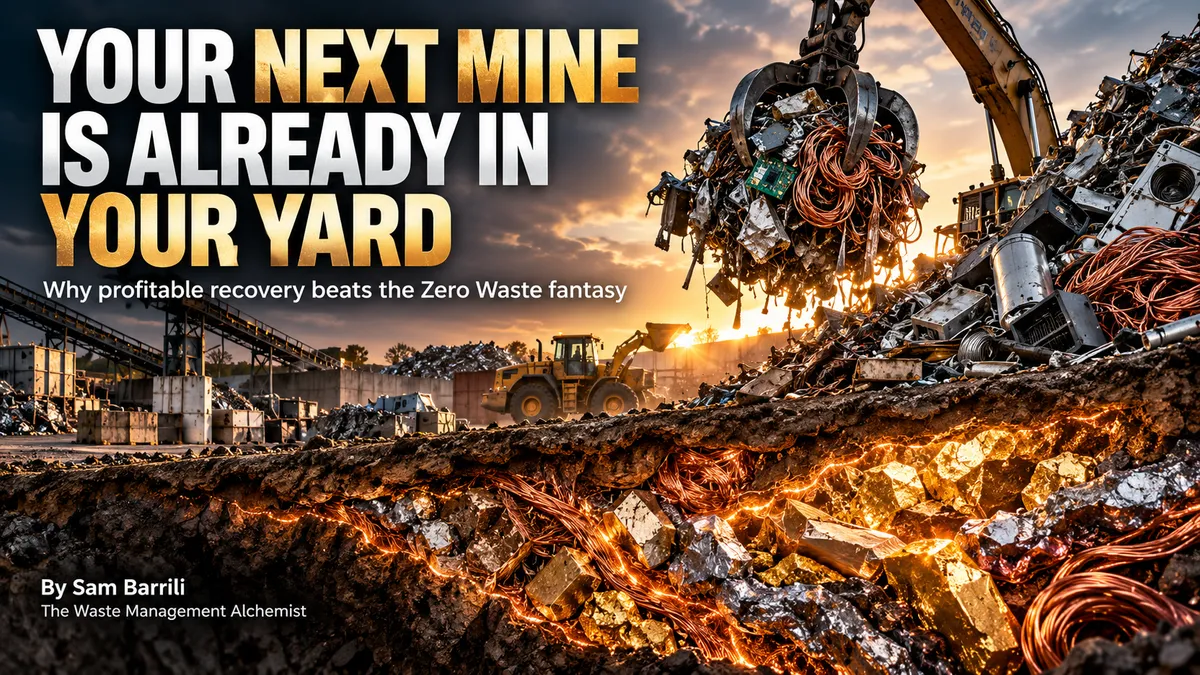
Your Next Mine Is Already in Your Yard
In late September, US diesel hit $6.53 a gallon. An all-time record. In October it was still above $6, roughly 70% higher than a year ago (FreightWaves, EIA data via FleetOwner).
Every ton of material that moves in the West now carries a fuel tax nobody voted for. Ore shipped across oceans. Scrap shipped out to Turkey. Pellets and parts shipped back in as finished goods.
Here is the uncomfortable truth: a large share of the material we import at that price is already here. It sits in our yards, our transfer stations, our landfills and our customers' back rooms.
We just call it waste. So we pay to move it away instead of selling it.
And when someone finally notices, the industry answers with the wrong goal: Zero Waste. A target physics will never let you reach, and a balance sheet will never let you afford.
The mine is already above ground
Lavoisier settled this in 1789: nothing is lost, nothing is created. The copper in a scrapped compressor is still copper. The steel in a demolished warehouse is still steel. Disposal is a word, not a chemical event.
Look at what the West is sitting on:
Electronics. The world threw away 62 million tonnes of e-waste in 2022, holding about $91 billion in raw materials. Only $28 billion was recovered. Copper, gold and iron lead the list (Global E-waste Monitor 2024).
Steel scrap. In 2025 the EU shipped 16.6 million tonnes of ferrous scrap outside its borders, worth €5.4 billion, staying a net exporter by 11.8 million tonnes (EUWID). Most of it goes to Turkey. Then Europe buys steel back.
Everything else. Only 12.2% of the materials used in the EU in 2024 came from recycled sources. Brussels wants 23.2% by 2030 (European Circular Economy Platform).
Even the regulators have noticed. The EU's new Waste Shipment Regulation, from May 2027, is set to cut major scrap buyers such as Egypt, India and Pakistan from the list of approved destinations (GMK Center). When governments start restricting exports of a "waste", it has stopped being waste.
Let me be honest about the limit. Our waste cannot supply 100% of what our factories need. Economies grow, and materials stay locked in buildings and infrastructure for decades. But the gap between 12% and what is technically and economically recoverable is enormous. That gap is the opportunity.
Zero Waste is an asymptote, not a destination
Here is where the Zero Waste story breaks. It treats 100% recovery as a finish line. Physics treats it as a limit you approach forever and never touch.
The Second Law of Thermodynamics is the reason. Mixing materials is free. Un-mixing them costs energy, and the cost climbs as the stream gets dirtier and the target gets higher. In The Zero Waste Lie I express it as the Asymptotic Effort Function:
E(R) = K / (1 − R)^n
R is your recovery rate. As R moves toward 1, the effort to get there moves toward infinity. The last 1% costs more than the first 50%.
So "we can't reach zero" does not mean "we can't recover more". It means something sharper: the money is in the steep, cheap part of the curve, and Zero Waste pushes operators to spend it on the flat, expensive tail.
That is the over-investment nobody priced in:
$400,000 AI sorters bought before the operator has mastered a single clean stream.
Municipal diversion targets that look good in a press release and lose money on every extra point.
Consultants and vendors whose business depends on you believing the next machine gets you to 100%.
The right target is not zero waste. It is maximum profitable recovery: the point where the next ton you recover still pays you.
$6 diesel just moved your optimum
Most commentators will tell you high fuel prices are good for recycling. Half true. Diesel cuts both ways, and the operator who sees only one side will get hurt.
It raises the value of local material. Every imported ton of virgin metal, resin or fibre now lands with a heavier freight bill. A clean, graded ton sitting 40 miles from the mill suddenly competes on price, not on virtue.
It also raises your own cost of chasing material. Your trucks burn the same diesel. Every extra dollar per gallon adds roughly $0.16 to $0.20 per mile to operating costs (American Action Forum). Driving 120 miles to collect a low-density, contaminated fraction so a city can report a higher diversion rate was a bad idea at $3.70. At $6.30 it is a margin killer.
Put both effects together and the profitable zone on the curve shifts. It moves toward streams that are:
Dense: high value per cubic metre moved.
Clean: sorted at the source, not on your floor.
Close: short distance to the generator and to the buyer.
Zero Waste logic says go further. Diesel says go smarter. The winners of this cycle will not be the operators with the highest diversion rate. They will be the ones who know exactly which streams pay, and stop moving the ones that don't.
What to do before the next fuel surcharge lands
You do not need a new plant to act on this. You need a sharper map of what you already control.
Rank your top five streams by profit per ton, not by tonnage. Volume flatters. Margin tells the truth.
Re-price every outbound load at today's diesel. Some streams you thought were profitable are now break-even.
Find the closest buyer who pays for quality. A local foundry, mill or processor beats a distant broker once freight is honest.
Fix contamination at the generator. Every point of contamination you accept is entropy you will pay to remove later.
Densify before you drive. Bale, shear, compact. Move value, not air.
Freeze any capex that only buys diversion percentage. If a machine does not raise profit per ton, it is buying a press release.
The full playbook
I wrote The Zero Waste Lie for the operators who are tired of being told to chase 100% and then left holding the bill.
It is not an environmental book. It is a business survival manual disguised as a physics lesson. Inside you will find:
The thermodynamics behind every recovery decision, explained for operators, not physicists.
The Asymptotic Effort Function, and how to find the profitable zone for your own streams.
Why the AI sorting pitch fails small operators, and when it actually makes sense.
The contamination penalty your broker never showed you.
The critical raw materials opportunity sitting in Western waste streams.
The five metrics and the expansion rules I use to run a stream-focused waste business.
Fuel will not stay at $6 forever. The physics will not change. The operators who learn the difference now will own the next decade.
Get your copy of The Zero Waste Lie here: https://bit.ly/47POYFV
To Your Success
Sam
P.S. If your trucks are burning $6 diesel to haul material someone else will profit from, read Chapter 3 first. It will change how you price your next load.

© 2026 Marketing4waste - All Rights Reserved,
Marketing4Waste is a brand of MiM MarketingInterimManagers LLC
+1 801 804 5730