Increase the Revenues of Your Waste Company With the Tips Shared in Our Blog Articles
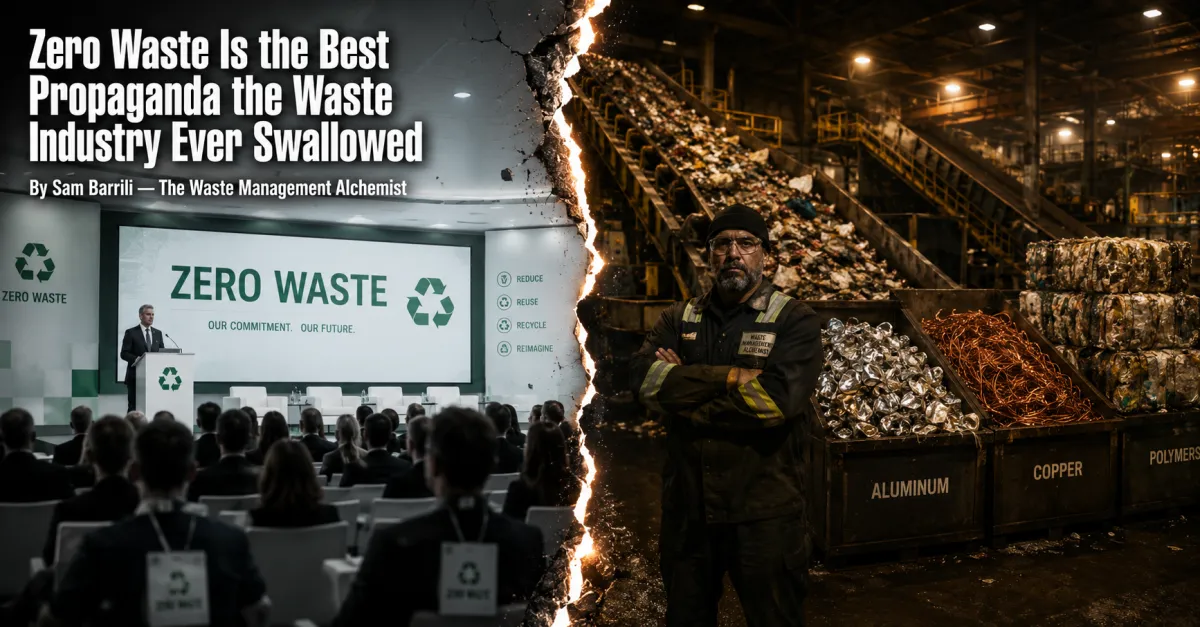
Zero Waste Is the Best Propaganda the Waste Industry Ever Swallowed
And it’s costing you real money every single day you keep believing it.
They Sold You Breakfast. Now They’re Selling You “Zero Waste.”
In the 1920s, Edward Bernays—the father of modern public relations—was hired by the Beech-Nut Packing Company to sell more bacon. He didn’t run advertisements. He didn’t offer discounts. He didn’t print coupons. Instead, he went to a physician and asked a single, carefully engineered question: “Is a heavier breakfast better for the American public?” The physician said yes. Bernays then circulated that medical endorsement to thousands of doctors across the country, and within months, bacon and eggs became the default American breakfast.
Nobody asked whether it was true in every case. Nobody questioned whether one breakfast model could apply to 130 million people with wildly different metabolisms, lifestyles, health conditions, and dietary needs. It didn’t matter. The idea was packaged with enough institutional authority that people simply absorbed it. The medical establishment repeated it. The media amplified it. Restaurants structured their menus around it. The frame became the fact.
I want you to hold that story in your mind, because exactly the same mechanism has been deployed inside the waste industry. Different product. Same playbook. Same result.
The phrase “zero waste” has been repeated so many times, in so many government reports, on so many conference stages, in so many corporate sustainability pledges, that most operators now treat it as a real, achievable destination. Something they should be working toward. Something that, if they just try hard enough, invest enough, sort well enough, will eventually arrive.
It won’t.
And the moment you understand why it won’t—not as an opinion, but as a matter of physical law—you stop wasting capital chasing a fantasy and start building a business around what actually works.
The Second Law of Thermodynamics Does Not Care About Your Mission Statement
Here is something no sustainability panel will ever tell you, because it would destroy the entire narrative they are selling:
Zero waste is physically impossible.
This is not my opinion. It is not a business preference. It is a law of physics. The Second Law of Thermodynamics tells us that in any transformation of matter or energy, entropy increases. Every time you process a material—sort it, shred it, melt it, reform it, ship it—some portion of that material’s usable value is permanently lost. Energy dissipates. Material degrades. Molecular structure weakens. Quality drops with every cycle. You cannot recirculate matter infinitely without loss. Not on a lab bench, not in a factory, not in an entire national economy. The physics will not bend to accommodate your diversion targets.
This is the concept I call the Asymptotic Limit of Circularity, and it is the single most important idea that waste management operators need to internalize right now.
Think of an asymptote in mathematics. A curve approaches a line, gets closer and closer with every increment, but it never touches it. You can invest more capital. You can optimize more aggressively. You can build better sorting lines, deploy more advanced optical separation, mandate stricter source separation at the municipal level. And the curve will move. Recovery will improve. But it will never reach zero. There will always be a residual fraction—material too contaminated, too degraded, too thermodynamically spent, or too economically irrational to recover.
That is not a failure of effort or ambition. That is the operating reality of the physical universe. And the sooner you build your business around that reality, the sooner you stop hemorrhaging money trying to fulfill someone else’s propaganda.
How the Propaganda Works
Bernays understood something that most people still don’t grasp, even a century later: you don’t change behavior by arguing. You change it by changing the environment in which people form their beliefs.
The “zero waste” movement operates on the exact same principle. It does not survive because the evidence supports it. It survives on repetition, institutional adoption, moral framing, and the silencing of dissent through social pressure. Consider how the machinery works:
Step one: Create a morally loaded phrase. “Zero waste” sounds clean, responsible, and final. Who could argue against zero? The very structure of the phrase makes opposition feel irresponsible. Arguing against zero waste is positioned in the same category as arguing against safety or public health. The language itself shuts down critical thinking before it can begin.
Step two: Embed it into institutional language. Once municipalities, regulatory bodies, the European Commission, and Fortune 500 sustainability departments adopt the phrase, it stops being an aspiration and becomes policy language. Policy language becomes budgets. Budgets become mandates. Mandates become the operating framework that every company in the chain has to navigate—whether or not the underlying goal is physically achievable. At that point, questioning the target feels like questioning the system itself.
Step three: Monetize the gap between the promise and reality. This is the part nobody talks about at the conferences. An entire consulting industry, certification ecosystem, reporting infrastructure, and compliance apparatus now exists to help companies “progress toward” a target that physics says they will never reach. This is not education. This is a permanently self-renewing business model built on a gap that can never be closed. As long as zero remains the target, the distance from zero remains a billable problem.
And the people paying the highest price? Waste management company operators. The people on the ground. The people actually touching the material, running the trucks, managing the sorting lines, and trying to make the economics work.
You are being asked to deliver on a promise that no one can keep, while the organizations setting that target collect fees, publish reports, and move on to the next conference keynote. That is not a partnership. That is a toll road.
What This Propaganda Actually Costs You
Let me be specific, because this is not an abstract philosophical problem. The zero waste illusion creates three concrete, measurable damages to your operation:
First, it misallocates your capital. When your entire strategic framework assumes everything can and should be recovered, you spend money trying to process materials that will never generate a return. Contaminated mixed plastics. Composite packaging that no recycler on the planet can economically separate. Degraded fiber that has already been through three or four recovery cycles and has lost its structural integrity. You invest in sorting capacity, labor hours, and floor space for fractions that no end buyer wants at any price. That is sunk cost driven by ideology, not by market logic.
Second, it blinds you to where the real value sits. While you chase the last 5% of material that will never be economically recoverable, you neglect the 40% to 60% of your incoming stream that contains real, monetizable secondary raw materials. Ferrous and non-ferrous metals. Specific polymer grades with stable market demand. Clean fiber with traceable sourcing. E-waste fractions containing recoverable critical minerals—cobalt, lithium, rare earths, copper, palladium. These are the streams that manufacturers are willing to pay premium prices for—if you identify them, separate them to specification, and build the commercial relationships to deliver them consistently. But you cannot see that opportunity clearly when your entire strategic lens is aimed at an impossible number.
Third, it prevents you from building a differentiated business model. Operators who organize their companies around zero waste targets end up commoditized. They compete on the same certification metrics, the same diversion percentages, the same generic sustainability narrative. There is no strategic moat in that. The competitive advantage comes when you understand which waste streams carry extractable value, how to control those streams from intake through output, and where to place the recovered materials for maximum margin. That is a business model. Zero waste is not a business model. It is a bumper sticker that costs you money every time you take it seriously.
What Smart Operators Do Instead
The operators who are building profitable, defensible waste management companies in 2026 are not chasing zero. They are doing something far more powerful and far more profitable. They are identifying their waste streams with precision, mapping the value inside each fraction, and building commercial systems around the outputs that generate real margin.
This is the core of what I teach through the SAM Method—Stream Advanced Management. The logic is direct:
Control what comes in. If you do not know what is entering your facility with granular accuracy—by material type, by contamination level, by source—you cannot extract value from it. Most operators accept material blindly and then wonder why their recovery economics are poor and their margins are thin. The problem did not start at the sorting line. It started at the gate.
Map what goes out. Every output from your operation—every sorted fraction, every residual, every byproduct—has a market position. Some fractions are worth significant money to the right buyer. Some are worth nothing. Some are actively costing you money to dispose of because you have not found the right downstream channel. Your job as an operator is to know the difference with precision and act on it with commercial intent.
Build relationships with the buyers who need your materials. Manufacturers across dozens of industries are increasingly desperate for reliable, consistent, well-characterized sources of secondary raw materials. Aluminum smelters, copper refineries, specialty polymer compounders, battery material reclaimers, glass cullet processors—these companies will pay premium prices for material that meets their specifications. But they will not come find you. You have to understand what they need, invest in meeting those quality standards, and position yourself as a material supply partner—not a waste company begging for a disposal pathway.
This is the shift that separates a hauler from a material provider. A hauler moves waste. A material provider controls streams, extracts value, and builds margin on every output. One business model is a commodity race to the bottom. The other is a strategic asset with defensible positioning.
The Asymptote Is Not Your Enemy. It’s Your Strategic Advantage.
Here is the part that nobody in the zero waste movement will ever voluntarily admit: the asymptotic limit is actually the best thing that could happen to your business.
Why? Because it tells you exactly where to stop investing in diminishing returns and start investing in what generates real, sustainable profit. It gives you a decision framework grounded in physics rather than politics.
When you internalize the asymptote, you stop pretending that every material is equally recoverable. You accept that some fractions will always end up as residual—and you plan for that outcome intelligently, not shamefully. Maybe that residual goes to energy recovery. Maybe it feeds into a cement kiln as an alternative fuel. Maybe it goes to a properly managed landfill with controlled cost. The point is: you stop treating that residual as evidence of failure and start treating it as an engineered outcome within a rational system.
Meanwhile, you concentrate your capital, your sorting technology, your team’s expertise, and your commercial energy on the fractions that generate real revenue. You get better at identifying critical minerals in e-waste streams. You get better at separating high-value polymer grades. You build long-term supply agreements with manufacturers who depend on your output. That is how you build a modern waste company. Not by chasing an impossible number, but by understanding the physics, respecting the economics, and building a business model around the value that is actually there.
The Choice in Front of You
You have two paths.
Path one: keep believing the propaganda. Keep chasing zero. Keep investing in recovery systems for materials that will never pay back their processing cost. Keep competing with every other operator who read the same report, attended the same webinar, and adopted the same aspirational language. Watch your margins compress year after year while someone else’s narrative controls your capital allocation.
Path two: step out of the frame entirely. Accept what the physics tells you. Learn where the real value sits inside your waste streams. Build the systems, the knowledge, and the commercial relationships to extract that value at scale. Transform your operation from a hauling business into a material business with strategic positioning and defensible margins.
Bernays sold America a breakfast that millions of people ate every morning without ever questioning where the idea came from. The zero waste movement sold this industry a target that thousands of operators are pursuing without ever questioning whether it is reachable. The difference is: now you know. And you can choose to stop.
This Is Where The Waste Alchemy Begins
Everything I described in this article—the asymptotic limit, the stream control logic, the shift from hauler to material provider, the economics of secondary raw materials—is laid out in full strategic detail inside my book, The Waste Alchemy.
This is not a textbook. It is not a sustainability manifesto. It is a strategic manual for waste management company owners and operators who are done chasing narratives that cost them money and are ready to build businesses that generate real profit from the materials they already control.
Inside, you will find the frameworks, the market logic, and the operational thinking that separate companies stuck in the hauling trap from companies building defensible, margin-rich resource businesses.
If today’s article made you rethink what you’ve been told about zero waste, the book will fundamentally change how you see your entire operation.
Get your copy of The Waste Alchemy here: https://bit.ly/4sQt4LQ
The propaganda will keep running. The conferences will keep repeating the same impossible targets. The question is whether you keep following—or whether you start leading.
To Your Success
Sam Barrili
The Waste Management Alchemist

© 2026 Marketing4waste - All Rights Reserved,
Marketing4Waste is a brand of MiM MarketingInterimManagers LLC
+1 801 804 5730