Increase the Revenues of Your Waste Company With the Tips Shared in Our Blog Articles
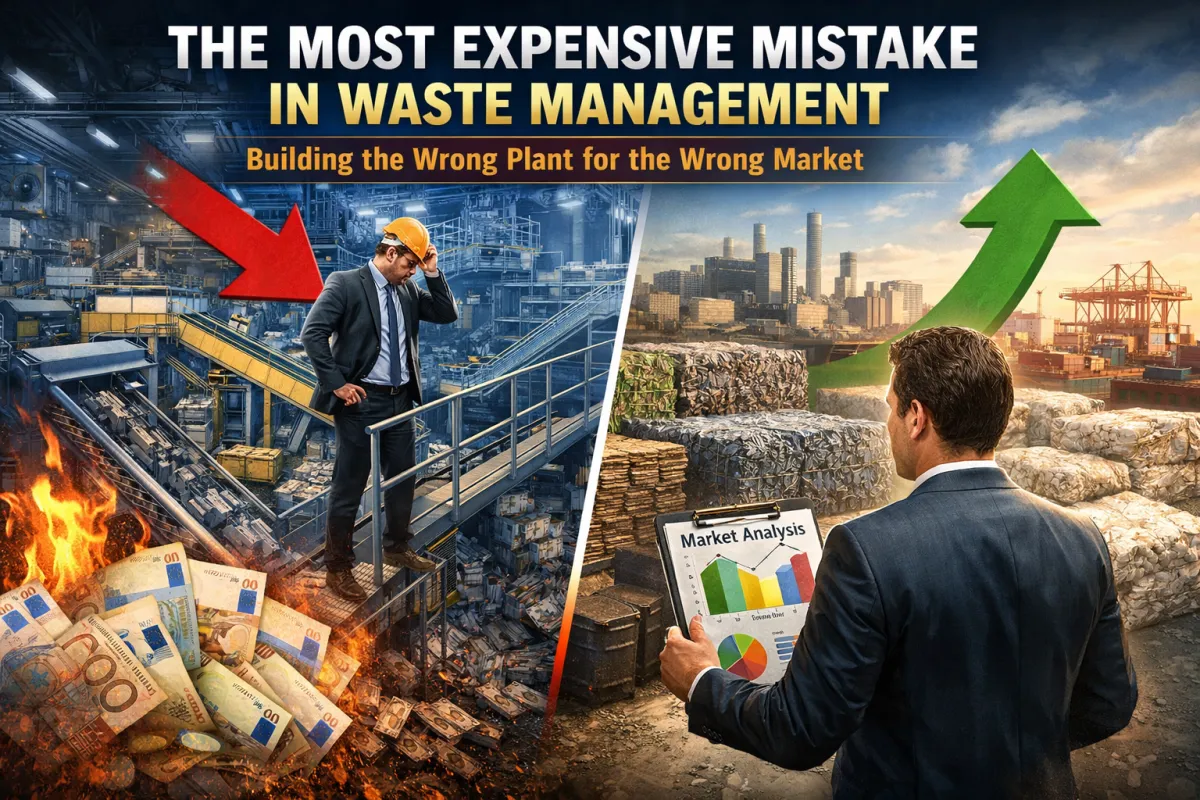
The Most Expensive Mistake in Waste Management: Building the Wrong Plant for the Wrong Market
Let me start with something that might hit a little too close to home.
Over the last 16+ years working inside waste management companies—on the ground, in plants, in negotiations, in strategy rooms—I’ve seen the same mistake repeated again and again.
Smart operators. Hard-working teams. Real capital.
Destroyed… not by regulation, not by competitors…
…but by building the wrong system for the wrong market.
Not because they didn’t have waste.
But because they didn’t understand what the market actually wanted to buy.
The Silent Killer: Confusing Waste Availability with Market Demand
Most waste companies start with the wrong question:
“What waste do I have?”
And then they move directly to:
“What plant do I need to process it?”
That sounds logical.
It’s also the fastest way to burn capital.
Because the real question is:
“What does the market want to buy—and in what format?”
If you skip that step, everything else becomes guesswork.
And guesswork in this industry is expensive.
A Real Pattern I’ve Seen Too Many Times
Let me give you a scenario I’ve personally witnessed dozens of times.
A company invests:
€500K, €1M, sometimes €3M+
Advanced sorting lines
Complex treatment systems
Automation, sensors, robotics
Everything looks impressive.
The plant is “state-of-the-art.”
And then reality hits.
The material they produce…
Is not in the format buyers need
Requires additional processing downstream
Has contamination levels slightly above spec
Doesn’t match the buyer’s production flow
Result?
Discounted prices.
Rejected loads.
Cash flow pressure.
And suddenly, that “advanced plant” becomes a liability.
Why This Happens (And Why It’s Not a Technical Problem)
This is not a technology issue.
It’s a positioning issue.
Because most waste companies think like this:
“If we process more, we create more value.”
That’s wrong.
Value is not created by processing.
Value is created by alignment with the buyer.
The Market Doesn’t Buy Effort. It Buys Fit.
A secondary raw material is not valuable because it exists.
It’s valuable because it fits into someone else’s system.
If your output requires:
Additional cleaning
Re-sorting
Re-processing
Extra handling
You are not selling a product.
You are selling a problem.
And problems don’t get premium prices.
What the Market Actually Wants
From my experience, buyers care about four things:
Consistency
Specification compliance
Predictability
Integration into their process
Not your plant.
Not your technology.
Not your effort.
Just this:
“Can I use this material without thinking twice?”
If the answer is yes → you get paid.
If the answer is no → you get discounted.
The Hidden Cost of Overengineering
Here’s where things get dangerous.
When companies realize they’re not getting the expected prices, they react by:
Adding more machines
Increasing complexity
Hiring more operators
Trying to “fix” the output internally
This creates a loop:
More complexity → higher costs → more pressure → worse decisions
And now you’re trapped.
The Strategic Shift Most Operators Miss
Let me simplify something that should be obvious—but rarely is.
You don’t start from the waste.
You start from the market.
Then you design backward.
The Reverse Engineering Model (What Actually Works)
Instead of:
Waste → Plant → Output → Market
You flip it:
Market → Specifications → Output Format → Process → Waste Selection
This is exactly what I’ve been applying for years through my work and frameworks
And this is where the gap between average operators and strategic players becomes obvious.
Why Most Small Waste Companies Get This Wrong
Because they are trained to think like haulers.
Move volume.
Increase routes.
Add capacity.
But hauling doesn’t create value.
It only moves it.
As I explain in The Waste Alchemy:
“If you only get paid for movement, you are trapped. If you get paid for what the material becomes, you are free.”
And that freedom starts with market analysis—not equipment.
The Illusion of “More Processing = More Profit”
This belief is everywhere.
And it’s dangerous.
Because processing without a buyer is just:
Organized cost.
Not value creation.
I’ve seen companies processing materials into formats that:
No one requested
No one specified
No one is willing to pay for
That’s not a business.
That’s a very expensive hobby.
The Secondary Raw Materials Reality Most Ignore
Let’s connect this to what’s happening globally.
Markets are shifting.
Supply chains are unstable.
Domestic sourcing is becoming critical.
As highlighted in recent market analysis:
Manufacturers are actively looking for reliable secondary raw materials
Demand is increasing due to geopolitical pressures
But quality and consistency remain the bottleneck
This creates a massive opportunity.
But only for companies that understand how to position their output.
The Real Opportunity (That Most People Miss)
You don’t need:
A bigger plant
More trucks
More volume
You need:
Better alignment
Better positioning
Better understanding of buyers
Because in many cases:
The difference between a $120/ton material and a $280/ton material is not the waste…
It’s how it’s prepared.
What I’ve Learned After 16+ Years in the Field
Let me make this very clear.
The companies that win are not the ones with:
The most equipment
The biggest facilities
The highest throughput
They are the ones that:
Know exactly what they want to produce
Know exactly who will buy it
Design everything around that
Everything.
The Dangerous Comfort Zone
Most operators stay stuck here:
“We’ve always done it this way.”
And they keep investing in:
Incremental improvements
Slightly better machines
Marginal efficiency gains
While completely ignoring:
Market dynamics
Buyer requirements
Strategic positioning
That’s how businesses slowly become obsolete.
The Truth Nobody Tells You
You can build a million-dollar plant…
…and still have a weak business.
Or you can build a simple operation…
…and dominate your niche.
Because:
The market rewards alignment, not complexity.
What This Means for You (Right Now)
If you’re running a waste management business, ask yourself:
Do I know exactly who buys my materials?
Do I know their specifications in detail?
Do I know what they reject—and why?
Do I know how my output fits into their process?
If the answer is unclear…
You don’t have a processing problem.
You have a market problem.
The Shift That Changes Everything
Stop asking:
“What plant should I build?”
Start asking:
“What does the market already want—and how can I supply it better than anyone else?”
That single shift can:
Save you hundreds of thousands
Increase your margins immediately
Position you as a supplier—not a seller
Where This Is Going (And Why You Should Pay Attention)
What I’ve shared here is not theory.
It’s what I’ve seen repeatedly across:
Europe
The US
Real plants
Real deals
Real failures
And this is exactly the foundation behind what I’m building next.
Modern Waste Companies (Coming Soon)
I’m putting together something very specific.
Not another “recycling course.”
Not another generic training.
But a complete operating system for waste companies that want to:
Stop chasing volume
Start controlling materials
Position themselves as resource suppliers
Because the future of this industry is very simple:
You either control the output…
Or you get controlled by the market.
Let’s Be Practical for a Second
You don’t need another article.
You need clarity.
Because every day you operate without alignment:
You’re leaving money on the table
You’re increasing risk
You’re making decisions without leverage
Book Your Strategic Call
If you want to:
Understand if your current setup is aligned with the market
Identify where you’re losing margin (and probably don’t see it yet)
Avoid investing in the wrong infrastructure
Then this is the next step.
👉 Book your free 20-minute consultation:
https://sambarrili.com/schedule-free-20min-call
No fluff.
No generic advice.
Just a direct, honest breakdown of where you are—and where you could be.
Because at the end of the day…
This industry doesn’t reward who works harder.
It rewards who understands the game better.
And once you see it, you can’t unsee it.
To Your Success
Sam
The Waste Management Alchemist

© 2026 Marketing4waste - All Rights Reserved,
Marketing4Waste is a brand of MiM MarketingInterimManagers LLC
+1 801 804 5730